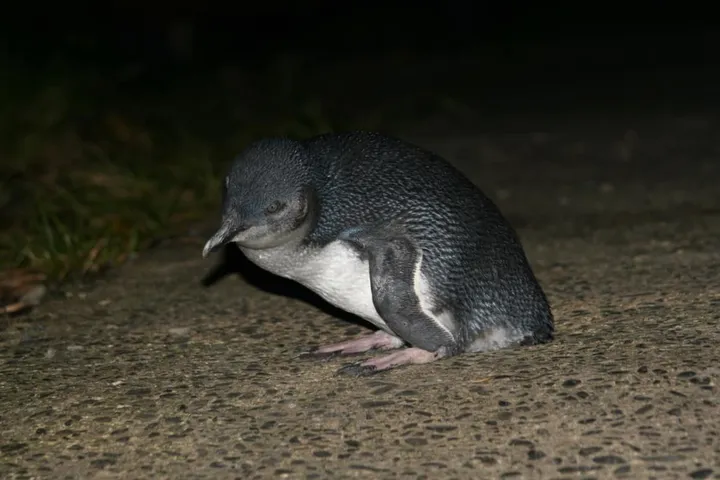
Yellow-eyed penguins hide their nests in the bush, a little farther from the neighbor, then farther still. For penguins this is unusual, because many penguins create presence through density: rows, crowds, and the force of being packed together.
Yellow-eyed penguins refuse that.
They seem to need their own room, their own path, their own quiet. Because of that, when they decline, the empty space becomes especially obvious.
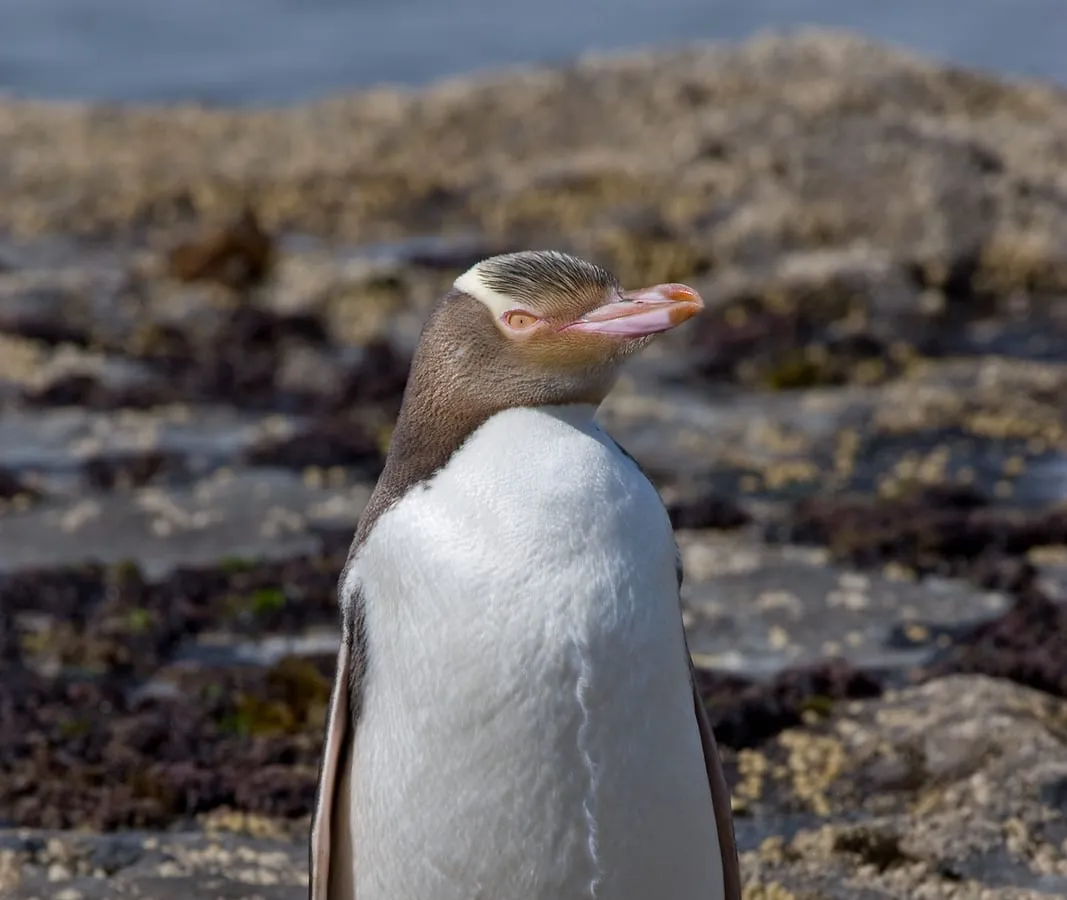
Yellow-eyed penguins are one of New Zealand’s large endemic penguins, about 62 to 79 cm tall and 3 to 8.5 kg in weight. The eyes are yellowish, and a pale yellow feather band crosses the back of the head. They are the only living species in the genus Megadyptes. They occur on the southeast coast of New Zealand’s South Island, Stewart Island, the Auckland Islands, and Campbell Island, and they like nesting in forest, scrub, and hidden coast.
It is hard to connect them with noisy, crowded colonies. Their philosophy of living is completely different.
They usually lay two eggs. Incubation lasts about 43 days, and chicks leave the nest after about three months. They feed mainly on benthic fish, squid, and similar prey, with parents going to sea and returning to a more scattered nesting area to feed chicks.
That way of living has a quiet concentration.
But once numbers fall, the weakness is clear. They cannot rely on the crowding of a huge colony to create an obvious presence. Lose a few pairs, and the whole landscape opens up.
They do not live by noise
Yellow-eyed penguins are not trying to squeeze into the world. They only want a little room to incubate eggs and raise chicks properly. That character is compelling and gives them dignity.
They do not use crowds to fill the stage. For penguins, that is a rare quality. But the world is not always gentler to quiet beings.
Yellow-eyed penguins face many pressures: disease, fishing nets, food stress, predators, and habitat problems. The IUCN figure is about 2,500 to 3,000 mature individuals; BirdLife’s estimate including subantarctic islands is about 5,930 to 6,970. The species is listed as Endangered. This is not a number you can comfort yourself with by saying there are many places to recover.
When you were never crowded to begin with, losing a few places makes the whole slope look empty.
The crisis of yellow-eyed penguins feels like a retreating tide. You visit today, and perhaps they are still there. Next year, it seems a little fewer. After a few more years, the path that used to be walked grows quiet.
This slow disappearance feels heavy because you can barely catch one clear change in time.
More and more blank space
Yellow-eyed penguins are often described as shy. That is a little cute, but not quite enough. They seem less like shy birds than birds unwilling to waste energy by forcing themselves into the wrong kind of noise.
They choose blank space.
When a species already leaves much blank space and the future keeps stretching that blank wider, it is no longer an aesthetic. It is a warning. Their foraging habits make the warning more concrete.
Yellow-eyed penguins often forage in relatively nearshore, fairly regular areas for bottom fish. Their routes and rhythms have inertia. Inertia can be efficient, and it can also be risk. When the seafloor environment, disease pressure, and human activity change together, the route that used to work may fail first.
That may be why they leave such an empty feeling.
They do not prove existence through noise. When they decline, the place does not become louder first. It becomes quieter. You are not frightened by a huge collapse. You are frightened by more and more blank.
Maybe we all know the world does not always reward quiet. But some lives need to be remembered exactly because they are quiet.
Yellow-eyed penguins walk slowly, live scattered, and do not look as if they are fighting for much.
Precisely because of that, they leave one question clearer: if nobody guards the things that do not exist by shouting, will only the wind remember them in the end?