
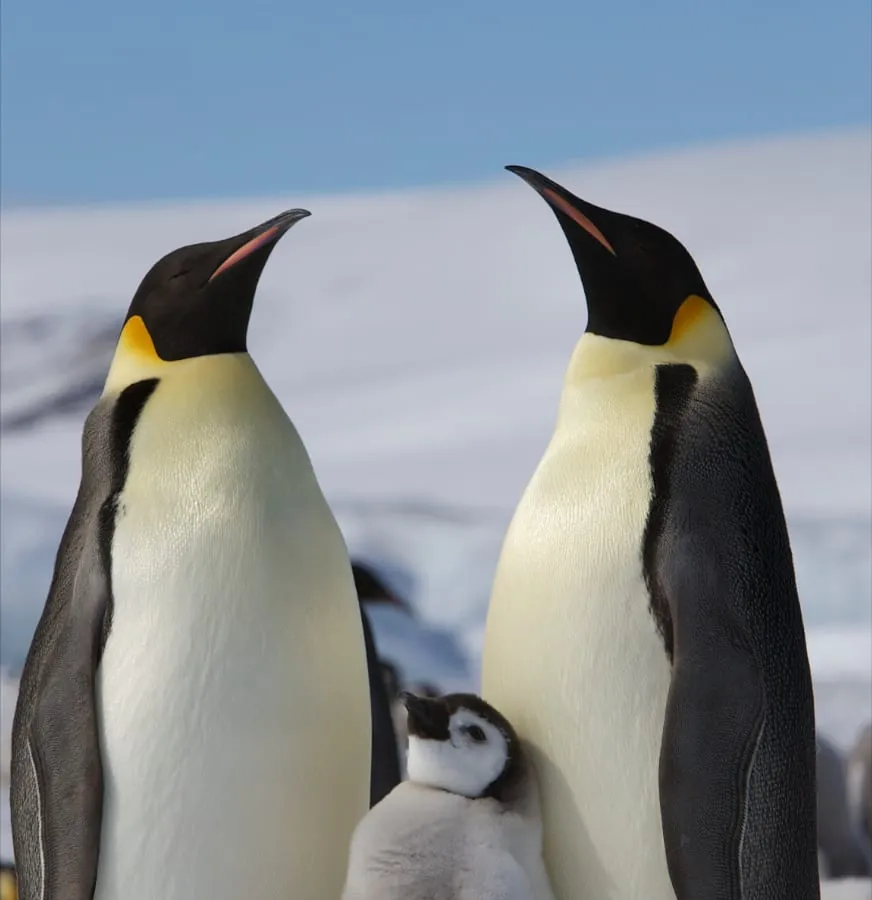
On an Antarctic winter night, a male emperor penguin holds an egg on top of his feet in winds below minus 30 degrees Celsius. For more than two months, he cannot let it touch the ice. It sounds almost like a legend. But he has to do it every day.
If the egg slips, it can freeze within minutes.
For an emperor penguin, fatherhood has never been soft work.
Emperor penguins are the largest of the 18 currently recognized living penguin species, about 100 to 122 cm tall and 22 to 45 kg in weight. They live on Antarctica and the surrounding sea ice, and they are among the few birds that place breeding in the Southern Hemisphere winter. The sea freezes, daylight shrinks, and storms hit like walls.
They choose this moment anyway, so chicks can grow enough feathers before the summer ice edge loosens and the sea becomes reachable.
Emperor penguins breed as if they are wagering against the seasons.
They usually lay only one egg. After the female passes it to the male, she returns to sea to recover. The male holds the small weight of life between his feet and belly brood pouch for roughly 65 days.
Australian Antarctic Program material notes that males may fast for 110 to 115 days through courtship and incubation. The stronger the wind, the faster their fat burns, and the egg still cannot be put down.
When the chick hatches, the work continues. The female has to return with food stored in her stomach before the male can go to sea to save himself.
Later, grey chicks gather into creches while adults take turns guarding and foraging. Before one chick fledges, each parent may need to provide about 42 kg of food.
Every wait on the ice eventually becomes one mouthful of fish.
They must also find one another inside a colony of tens of thousands. Antarctic wind scatters sound and snow blocks sight, but parents and chicks still recover each other by voice.
The messier the world becomes, the more tightly they need to hold that thin line.
A colony that slows the storm
Once you have seen emperor penguins in a huddle, the image is hard to forget: white wind outside, a black-and-white circle breathing slowly inside.
Antarctic storms can reach 200 km per hour. Emperor penguins answer by moving closer. On the coldest days, 10 males can fit into one square meter, and the temperature inside the huddle can rise to around 24°C.
They rotate too. Birds on the windward edge slowly move along the side and toward the back, while warmer birds take their place. The group turns like something very slow inside the storm.
It can look as if nobody is moving. In fact, every bird is taking a few minutes of pain for someone else.
After a 48-hour blizzard, a colony may have been pushed 200 meters by the wind. What holds them together is that no one leaves first.
Another face under the sea
On the ice, emperor penguins look steady.
In the water, everything changes.
They chase fish, squid, and krill, dive hundreds of meters, and have records beyond 500 meters. British Antarctic Survey and Australian Antarctic Program sources both describe them as some of the strongest deep divers among penguins, able to hold breath for more than ten minutes in the dark sea.
Adults usually eat about 2 to 3 kg a day, and more before molting or breeding. They are precise hunters, cutting under the ice like torpedoes.
Risk is everywhere: leopard seals near the ice edge, skuas and giant petrels around eggs and chicks, killer whales in the sea. Emperor penguins eat, and they can be eaten.
On the ice they endure. In the sea they surge.
Their awkwardness and precision belong to the same body.
They know when to be slow and when to be fast.
A floor that is becoming less reliable
The real trouble is that the sea ice under their feet is becoming less dependable. Emperor penguins need coastal fast ice for breeding; eggs and chicks have to wait there until chicks have waterproof feathers. Recent British Antarctic Survey observations found several colonies failing almost entirely when sea ice broke early and unfledged chicks fell into freezing water.
In April 2026, the IUCN Red List assessment by BirdLife International, the IUCN Red List Authority for birds, and the IUCN SSC Penguin Specialist Group moved emperor penguins from Near Threatened to Endangered. The reason is direct: as sea ice shrinks, the nursery floor breaks too.
They are beautiful, with pale yellow chests and gold near the ears. But the images move us because every step rests on real wind, hunger, and cracking ice.
What makes emperor penguins hard to look away from is that in the coldest place in the world, they still stand until dawn for one egg.
The Antarctic wind has always been strong.
What is truly rare is that some still choose to stand together.