A six-centimeter crustacean carries an entire Antarctica on its back.
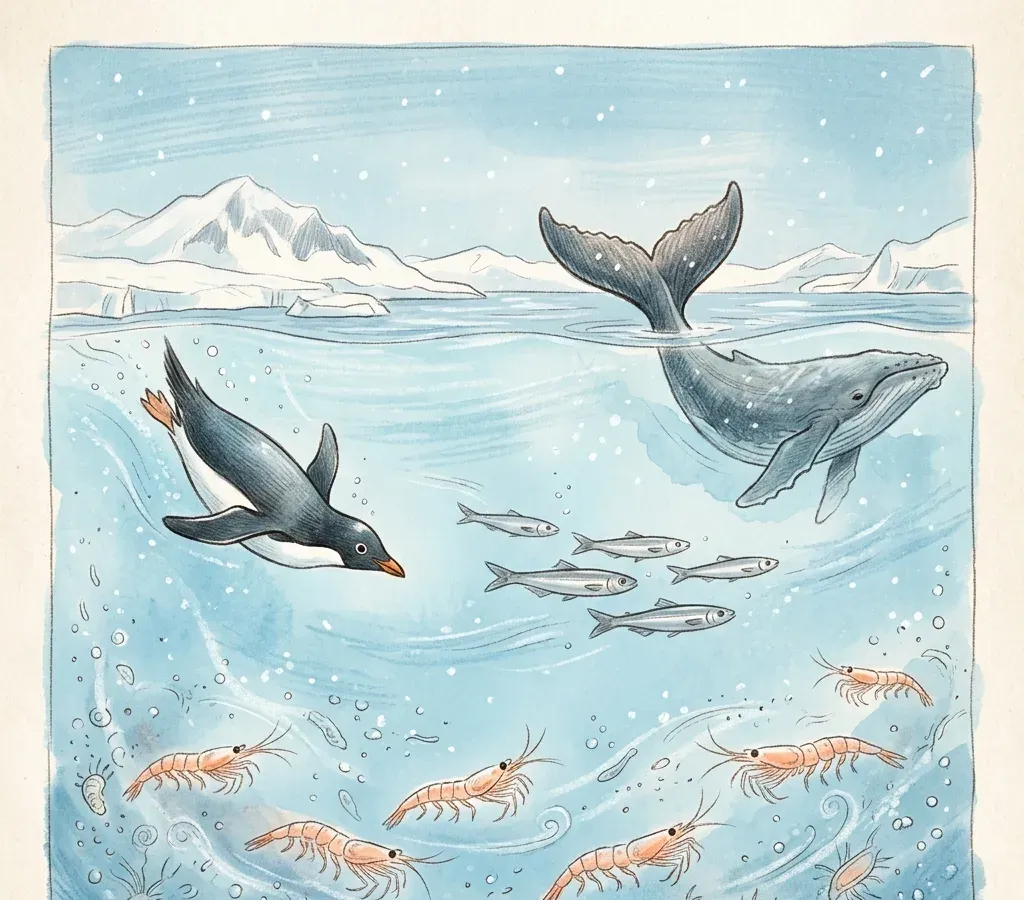
It is tied to the stomach of a seal, the stomach of a penguin, and the mouth of a whale, all pulled along by the same line.
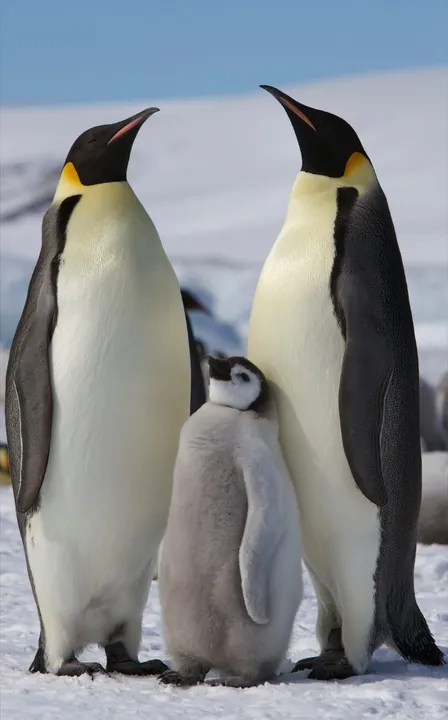
I used to think penguins were the main characters. The more I checked, the more I realized that in the food web of Antarctica, they sit closer to the middle. Above them are leopard seals and orcas; below them, translucent little krill push protein upward through the system. Penguins chase fish themselves, and they can become someone else’s dinner at any moment.
This web looks complex, but it becomes much clearer if you start from the smallest layer.
Everything begins with 6 centimeters
Adult Antarctic krill are about 6 centimeters long and a little over one gram. They gather in enormous swarms, eat phytoplankton and algae under sea ice, and turn sunlight into protein that can be swallowed bite by bite.
The Australian Antarctic Program calls them Antarctic superfood.
The name is vivid. Fish depend on them, squid depend on them, albatrosses and petrels depend on them, and baleen whales, seals, and penguins depend on them too. Many Antarctic animals look very different, but their stomachs often connect to the same thing.
Some names can even mislead you. Crabeater seals sound as if they eat crabs, but their main food is almost entirely krill.
In Antarctica, the true main character is often the smallest one.
Recent NOAA research keeps placing krill at the center. Population changes in Adelie penguins, chinstrap penguins, and gentoo penguins move together with krill supply and ocean conditions. When krill decline, the whole web loosens.
Every penguin you see is really carrying an entire ocean ledger.
Sea ice is floor and nursery
I had not thought about this layer before checking.
Many juvenile krill hide under sea ice and graze on algae, like tiny things hanging upside down from an ice ceiling. When sea ice area, thickness, and duration change, their nursery shrinks or shifts too. Once the base wobbles, every layer above it trembles.
Monitoring data from the British Antarctic Survey puts it plainly: high krill years are often linked to broad winter sea ice in the previous year.
Sea ice in Antarctica is never just a backdrop. It is floor, nursery, and the starting point where krill pass phytoplankton upward into the visible world.
Penguins stand in the middle
Penguins are special because they are predators and also someone else’s food.
Small Antarctic penguins often eat large amounts of krill, while emperor penguins and king penguins more often chase fish and squid. They dive under the ice, bodies like black-and-white arrows, cutting toward the densest part of the fish schools.
If you draw the Antarctic food chain as a straight line, it becomes too simple. In reality it is a knotted web: fish eat krill, squid eat fish, and penguins change their menu with the season. When today’s ice conditions, currents, or fish locations change, their whole day has to be rearranged.
They look like stars at center stage. In reality, they are calculating every day.
How long to stay at sea, where to come ashore, whether to feed themselves first or hurry back to feed the chick: every decision is tied to ice and food. Antarctica is not romantic enough for cuteness alone to survive.
Pull the camera farther back and you see that no one in the food web really exists alone. The fish a penguin eats may have swallowed a bellyful of krill the day before. The ice-edge channel guarded by a leopard seal may also be the closest route for a penguin returning to the nest.
Antarctic cruelty never needs exaggerated lines. It sits quietly inside routes, energy, and timing gaps.
Bigger mouths wait at the ice edge
Above penguins are bigger mouths.
Leopard seals are the classic example, often waiting beside the ice edge for the moment a penguin leaps into the water. Orcas also eat penguins and seals. On land or ice, south polar skuas and giant petrels watch eggs and small chicks.
Every time a penguin fills its stomach, it also has to avoid becoming someone else’s dinner.
That pressure makes the whole web tight. Catching krill is already hard enough; the return trip still has to cross a channel guarded by leopard seals. Just when a seal seems powerful, an orca is patrolling the outer ring.
Antarctic quiet is a kind of illusion. The surface is flat; underneath are speed and waiting.
The web breaks together, not strand by strand
The most unsettling part is that this whole web is now being pulled at once.
Less sea ice and altered sea-ice seasons affect the environments where phytoplankton and juvenile krill can hide and feed. When krill fluctuate, penguins, seals, and whales feel hungry with them.
Add the Southern Ocean krill fishery, which is concentrated in certain areas. When I was checking CCAMLR data, one detail stood out: the total quota looks conservative, but in the 2024-25 fishing season, the quota was filled early for the first time in history and the season was forced to close; fishing activity doubled in hotspot Area 48.1. Area 48.1 is where chinstrap and gentoo penguins feed chicks in summer.
NOAA has also warned that even if the overall catch looks conservative, local competition can still pressure predators such as penguins.
That is why I later decided not to choose krill oil. After checking, I realized the total amount is not the key point. Location is. Area 48.1 lies right on the feeding grounds where chinstrap and gentoo penguins raise chicks. I wrote more fully about that in the krill oil article.
One piece of cloth, shaking together
The Antarctic food chain is not like an arrow diagram in a textbook.
It is more like a tightly stretched cloth. When the lowest line loosens, every layer above it trembles.
What penguins eat, and who eats penguins, cannot be answered only by looking at penguins. The answer is also hidden in those 6-centimeter, translucent, shining little animals; in the thinning sea ice above their heads; and in which patch of ocean distant fishing vessels plan to work this season.
After reading through these materials, what I think about most is not how tragic penguins are or how crucial krill are. It is that every line in this web reaches a little farther than I originally imagined.
The truly impressive thing about Antarctica is that the whole sea still has something to eat.
How long that can hold is what I am still reading about.
References
Krill, sea ice, and the Antarctic food web
- Atkinson et al., 2004, Nature
- Saba et al., 2014, Nature Communications
- Cavan et al., 2019, Nature Communications
Penguins, predators, and fishery overlap
- Hinke et al., 2017, PLOS ONE
- Warwick-Evans et al., 2022, Frontiers in Marine Science
- CCAMLR Fishery Report 2024 (2025-04-07)
FAQ
Are penguins the key animals in the Antarctic food chain?
No. Penguins are mid-level predators. Antarctic krill at the base move energy from phytoplankton and sea-ice algae upward to fish, seals, whales, and penguins.
What do penguins mainly eat in Antarctica?
Adelie, chinstrap, and gentoo penguins often eat large amounts of krill; emperor and king penguins more often pursue fish and squid. The menu changes with ice conditions and prey location.
Why does sea ice affect penguin food?
Juvenile krill often feed on algae under sea ice. Years with broad winter sea ice in the previous year are often linked to high krill years; when sea ice declines, the whole food web shakes.