On land, a gentoo penguin often looks busy: picking things up, repairing the nest, walking quickly as if there is a list in its head. In the water, the same body changes. The lines straighten, the speed rises, and the bird suddenly looks solved.
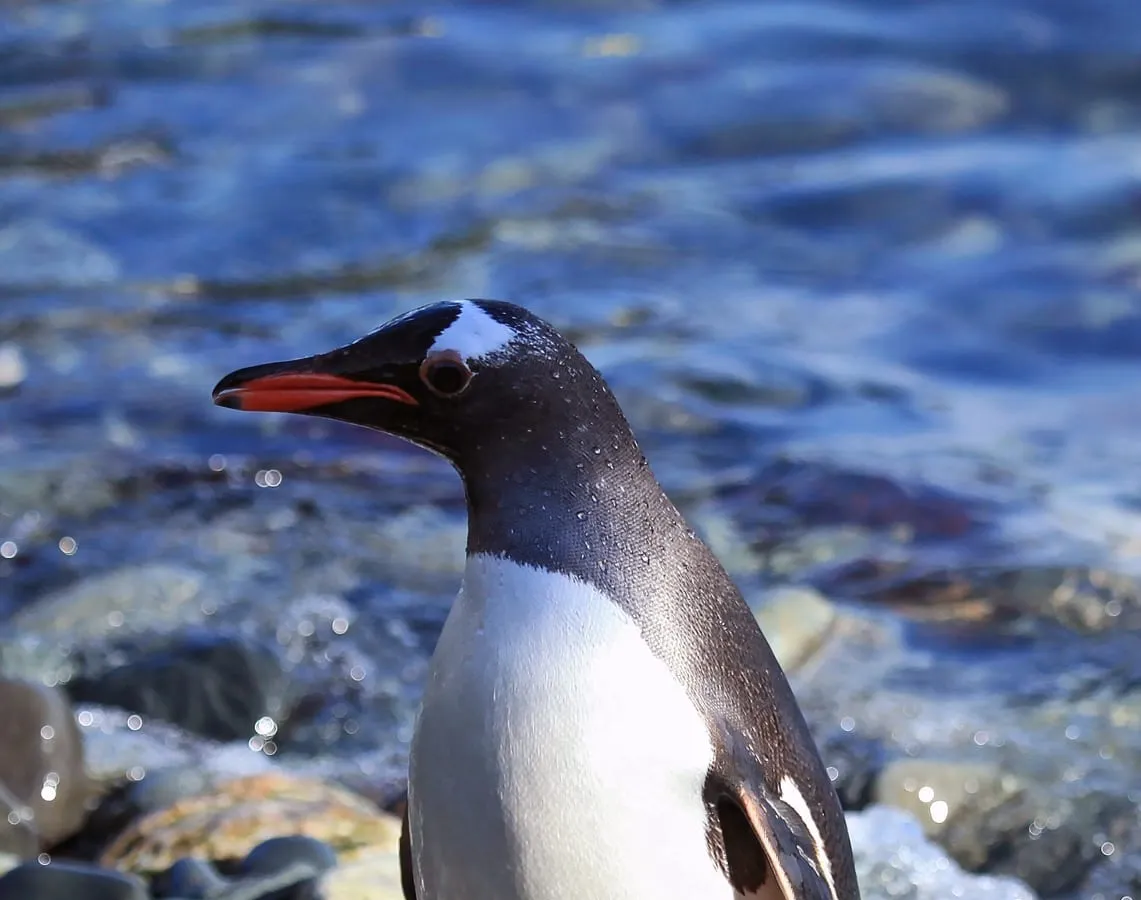
Gentoo penguins stand about 51 to 90 cm tall and weigh about 4.5 to 8.5 kg. The white band across the head is easy to see, and the bill and feet are orange-red. They live around the Antarctic Peninsula and subantarctic islands, and belong to Pygoscelis with Adelie and chinstrap penguins.
They prefer ice-free coasts and build nests from stones, grass, and feathers. They usually lay two eggs; incubation takes about 35 days, and chicks fledge after roughly three months.
The sea is their real field
Gentoo penguins are often counted among the fastest swimming penguins. On shore they deal with stones, wind, slopes, and neighbors. In the sea they only need to move forward, and the body makes sense immediately.
They are also flexible. Fish, squid, krill: all can be food. Newly ice-free coasts can become breeding space. In parts of the Antarctic Peninsula, this flexibility has helped some populations expand southward.
The species is listed as Least Concern, with more than about 600,000 mature individuals. Still, pollution, fisheries competition, tourism disturbance, and local colony declines remain real. Flexibility is a strength, not an endless buffer.
The gentoo penguin’s answer is quiet and practical: adjust the route, change the menu, add another stone. The question is whether the sea can keep giving it room to do that.