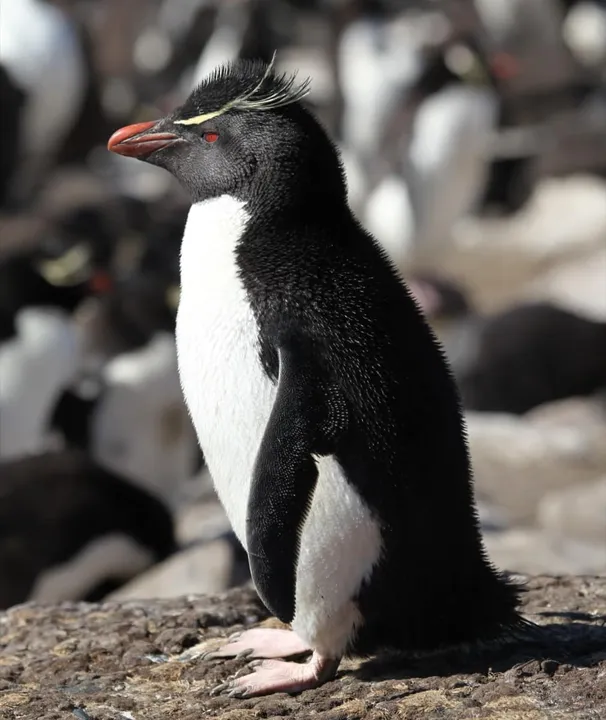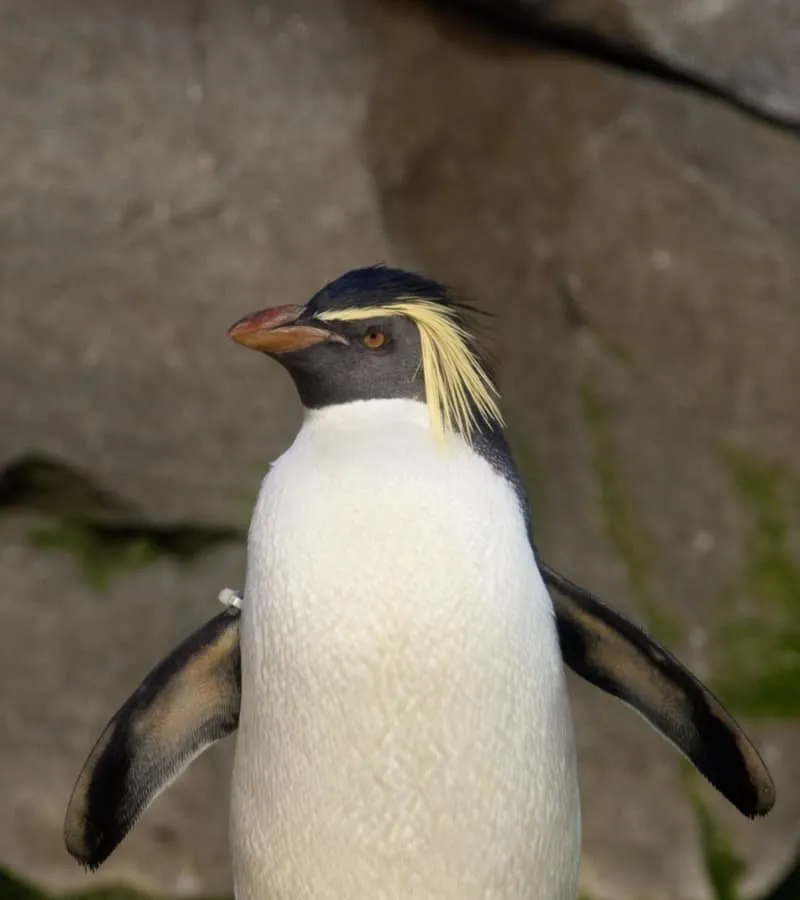
Some places on Earth are so far away that you almost assume living there must be safer. Northern rockhopper penguins break that idea.
Their main breeding sites are Tristan da Cunha, Gough Island, and the still more distant Amsterdam and Saint Paul islands. To most people, those names sound like footnotes at the edge of a map. Yet northern rockhopper penguins have continued to decline there.
Northern rockhopper penguins are about 52 to 55 cm tall and 2.5 to 3.4 kg in weight, with thick yellow brows, fierce eyes, and the same springing movement as southern rockhoppers. They live on wind-hardened island shores, hop when moving, and often show a clear difference between their two eggs. From the outside, they look like penguins that would not be easy to defeat.
But real trouble often does not grow on the outside.
It grows in the sea.
Research and conservation assessments show a heavy fall since the mid-20th century, often described as a long-term decline of around 90%. Current common estimates are about 200,000 to 260,000 mature individuals, and the species is listed as Endangered. The problem is not only the number, but also the concentration of breeding sites in a few remote islands.
If marine conditions worsen, predation pressure shifts, or one island has repeated bad seasons, they have few alternatives.
The faraway can still be touched
What makes northern rockhopper penguins stop you is not how well they jump. It is that they show distance is not safety.
Many people instinctively feel that places farther from human society must be cleaner. Sometimes that is true. But the ocean is not a fenced garden.
Sea temperature, fish, food webs, pollution, and climate swings all cross the long spaces on a map. Northern rockhopper penguins are a kind of evidence.
Real protection is not only putting a species somewhere few people go. It also depends on whether the sea itself can still hold.
They can avoid cars, cities, and walking paths. They cannot avoid the whole marine system moving in an unfavorable direction. That pressure feels especially powerless.
You do not see what it looks like day by day. You read it slowly through fewer birds one year, then fewer again the next.
Their way of living is tough. Rocky ground is hard, so they jump. Wind is strong, and they still nest.
If there are not enough resources for two eggs, they concentrate the odds on the larger second egg. Every step is practical.
That makes the decline harder to take, because it is clear the bird has already done what it can. What remains is called environment.
Remote is not the same as fine
Northern rockhopper penguins also feel like a modern misunderstanding. We often think that moving away from the center of trouble means avoiding trouble itself. But some changes do not walk in from a street corner.
They seep out of the whole system. No matter how far you move, they still find you.
Researchers also need long patience to understand them: landings on remote islands, long-term photo comparisons, and scattered population records have to be stitched together before the trend becomes visible.
That means they did not suddenly become fewer. They have been scheduling disappearance in places very few people see.
That slow downward feeling is painful because it has almost no drama. No great crash, only decades of a little less.
Northern rockhopper penguins live in the farthest places and decline in the most ordinary way. That ordinariness is harder to accept, because it means the world really can thin a species where almost nobody is watching.
So what makes them unforgettable is not only the sharp yellow brows, but the warning they write from remote islands that is not remote at all.
The question was never whether you live far enough away. It is whether the sea still agrees to let you live.