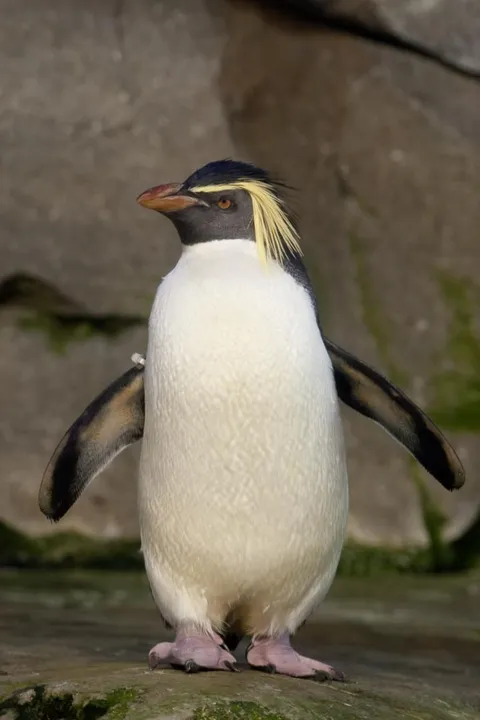
If a southern rockhopper penguin finds a rock wall in front of it, it often does not seem interested in finding an easier route. It jumps.
The image has force, like a wound-up little spring bouncing upward.
Many penguins read as comical. Southern rockhoppers read more as stubborn.
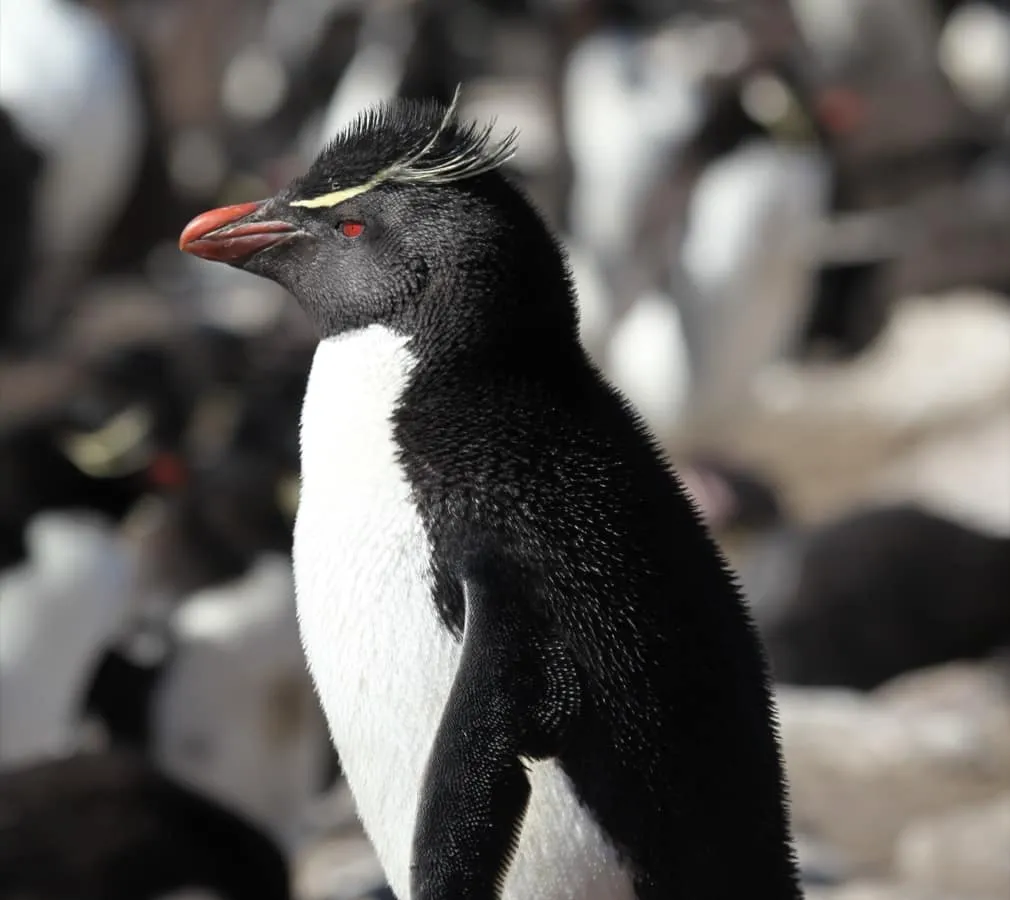
With red eyes, yellow brows, short legs, and stiff movements, this does not look like a bird willing to let terrain decide for it.
Southern rockhopper penguins are about 45 to 58 cm tall and weigh about 2 to 4.5 kg. They live on subantarctic islands off southern South America and around the Falkland Islands.
Their places are often steep, messy, and windy. Breeding sites sit near rock slopes and platforms where waves can reach.
That terrain suits them. If you can jump, broken ground becomes an advantage.
They are not like emperor-type penguins that must walk a long, steady route. They are more like creatures that break difficult ground into many small leaps.
Their breeding is famous because it is harsh. A clutch usually has two eggs, but the first is smaller and the second much larger.
Most often, only the chick from the second egg grows successfully.
This strong egg-size difference is common in the crested penguin group. Southern rockhoppers make it especially direct.
Their life may look jumpy and impulsive, but behind it sits a very cool logic of resource allocation.
Beautiful and hard to mess with
The swept-back yellow brows and red eyes pull the whole face into a fierce shape. Southern rockhoppers are not the flashiest stars among penguins, but they are hard to ignore.
The look fits the behavior, because this is not a slow-tempered bird.
Colonies are loud, crowded, and urgent. They have to hold their place there.
But outside pressure is real. Changes in marine food webs, fisheries, human disturbance, and long-term declines at some large colonies have led the species to be listed as Vulnerable.
About 2 million mature individuals sounds like a lot, but the number is held together across many islands and years.
If several important colonies do badly in sequence, the overall trend turns downward. Southern rockhoppers always look full of energy.
But what may break them is usually not the rock wall in front of them. It is more likely something slowly changing in the sea.
Food a little farther away, climate a little worse, success a little lower.
Many declines do not fall suddenly. They are worn down.
Jumping does not cancel the cost
Their classification story is interesting too. Several rockhopper penguins were once often treated together, and only later were different lineages and ranges separated more clearly.
Once the names are separated, it becomes easier to see that each sea area carries different pressures. Birds that look similar may still have their own difficulties.
Southern rockhoppers therefore feel like creatures that seem fast on the surface but step on limits every time.
They can jump, push, and guard. None of those skills cancels the cost. The more capable they look, the more clearly you see how they hold themselves inside narrow conditions.
Thinking of southern rockhopper penguins means thinking both about how they jump and how they abandon.
Only one line is kept from two eggs. That is their reality.
Many life strategies look stylish on the surface, but underneath are precise losses. Southern rockhopper penguins simply live that more plainly.
The jump is beautiful. What stays longer is that after landing, the bird still has to choose.
It jumps so cleanly, yet lives with careful calculation. That contrast is the hardest part of the southern rockhopper penguin.