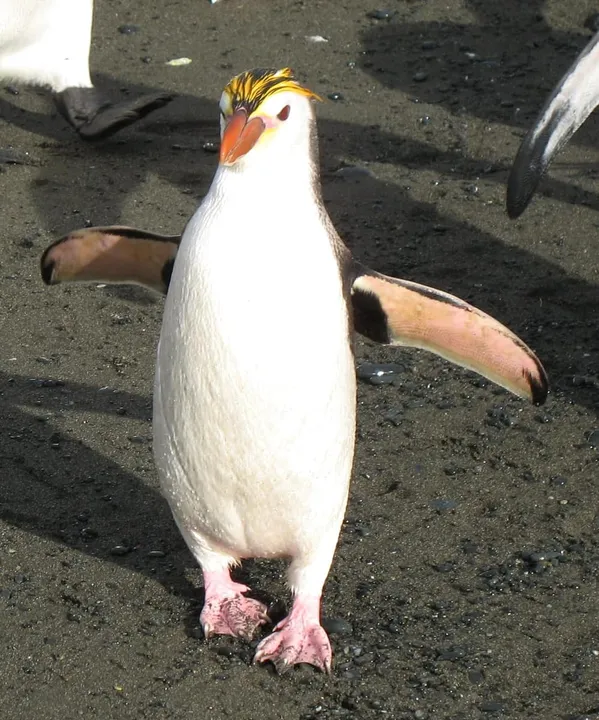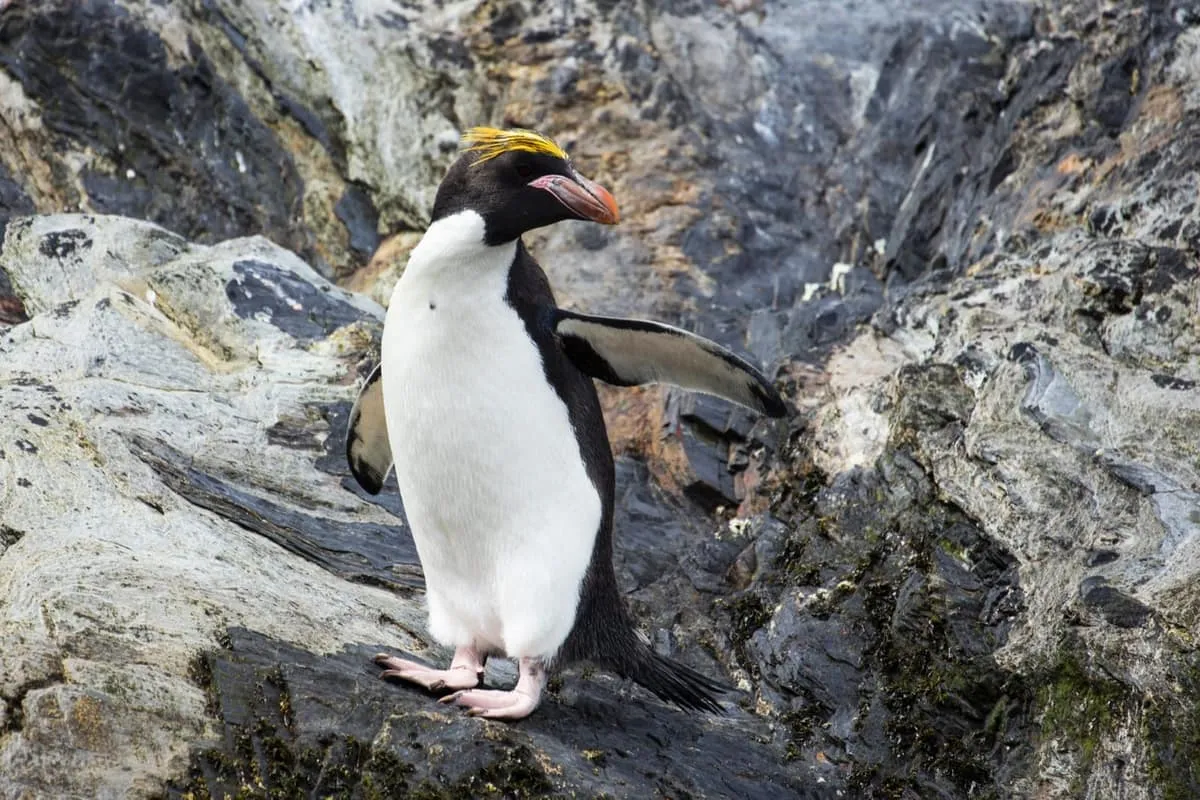
If a whole hillside is filled with macaroni penguins, the color catches you first.
Above the black-and-white bodies, rows of yellow brow crests look like grass moved by wind. The colony has a restless feel.
One of these penguins is already flashy. Thousands together feel more like a coastal mass movement.
Macaroni penguins are about 70 cm tall and weigh about 5 to 6.5 kg. Their range stretches from the subantarctic to islands around the Antarctic Peninsula, and they are among the most numerous penguins alive. There are about 18 million mature individuals.
That “many” can make people exhale. But the most important thing to notice is that even with such a large total, macaroni penguins are still listed as Vulnerable.
The question is not only whether there are many. It is whether decline has become large enough for even a huge population to feel it.
They depend heavily on Southern Ocean krill, and also eat small fish and squid. During breeding, a clutch usually has two eggs, but like other crested penguins, the first egg is usually smaller, and the chick that is truly raised is usually from the second egg.
The strategy is practical, and cold.
Inside a huge colony, each pair is making its own small decisions. Thousands of small decisions pile up, and the result is a field of yellow crests moving in sea wind.
Many does not mean loose
Macaroni penguins force you to rethink what “many” means.
Many can feel like safety. But for a large population dependent on a single marine resource, many may only mean that it has a larger machine to feed.
If krill becomes unstable, the effect is often system-wide. It does not fall on just a few families.
When a large colony begins to perform poorly, the problem is not small.
They are also noisy penguins. Colonies are dense, slopes are narrow, and everyone is breeding, changing shifts, and holding space.
Standing in such a place, it is hard not to feel pressed by sound and density.
The noise is not only liveliness. It is like collective breathing. Each bird is speaking to the sea, saying it still needs that mouthful of krill and that trip home.
Many large colonies have recorded declines in recent years. Warming, food change, and human pressure may all be part of the cause.
The story is not a straight line of “almost gone.” It says something harder: still many, but no longer safe to ignore.
That is harder than simple tragedy, because large numbers easily numb people.
Fancy is not easy
The yellow crest makes macaroni penguins easy to remember. They look like the best-dressed characters on the shore, and the name really does come from fashion.
But the brightness carries a contrast. The flashier they look, the more practical the life is.
Where food comes from, which egg is kept, which path is taken: all of it is realistic.
At huge breeding sites such as South Georgia, the scale can briefly erase distance. The shore no longer looks like shore, but like a moving carpet.
The more overwhelming the scene, the more clearly it shows how concentrated their dependence on the sea is. If the sea thins, the yellow thins first.
Macaroni penguins enlarge success and vulnerability at the same time. Big numbers and big scenes make everything look steady, but if the system turns, that turn is enlarged too.
They seem to say that size is not immunity. Size only means more things have to hold together.
Outside, the colony looks busy, stable, and full of surplus.
Inside, it is maintained by countless precise small movements.
Macaroni penguins live this visibly. The question is, when the sea becomes less stable, how long that yellow grassland can keep moving is not something anyone should answer too early.
Sometimes the lives that most need serious protection are exactly the ones that look too numerous to be in trouble.