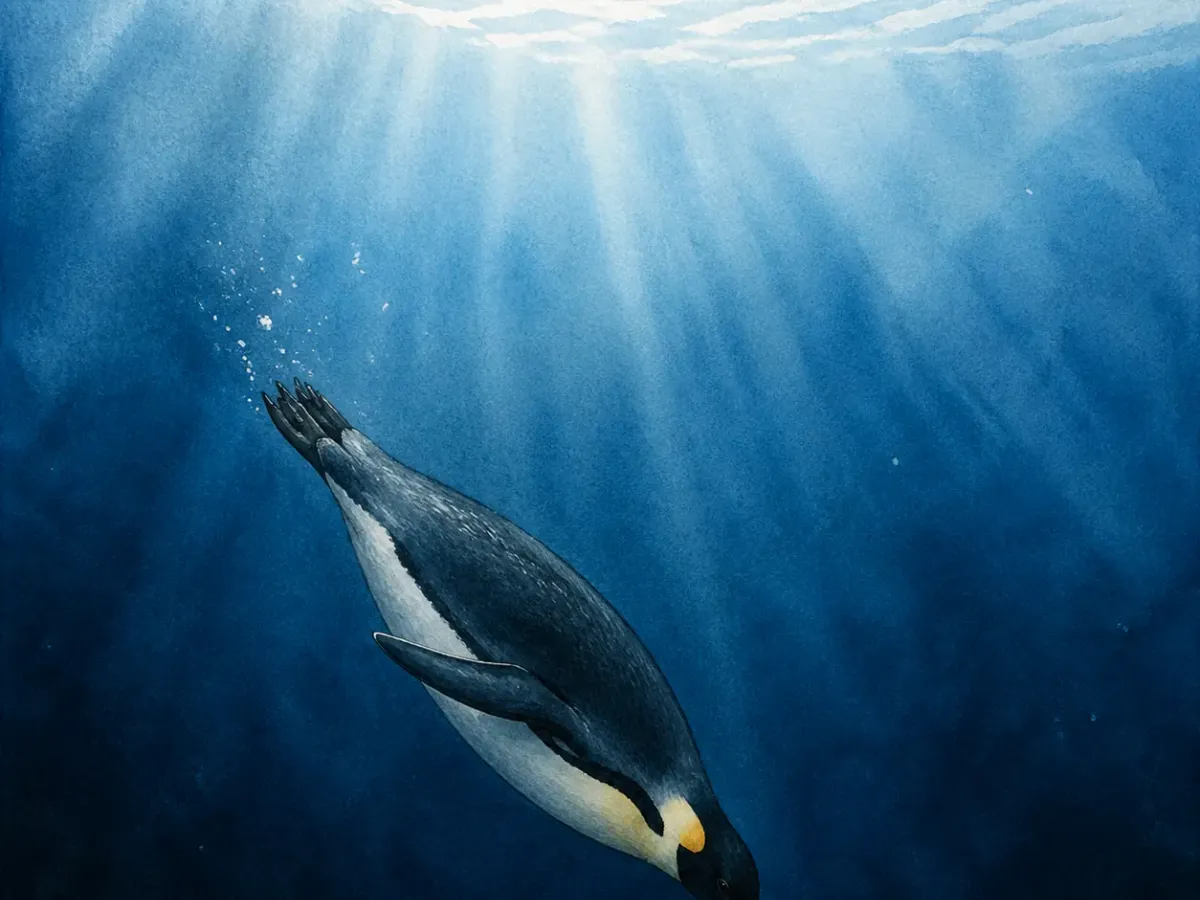
After writing the Antarctic food chain article, I kept thinking about one thing.
In that web, penguins look like they sit somewhere in the middle. But when a penguin goes into the sea to find food, what it does is much more extreme than I had imagined.
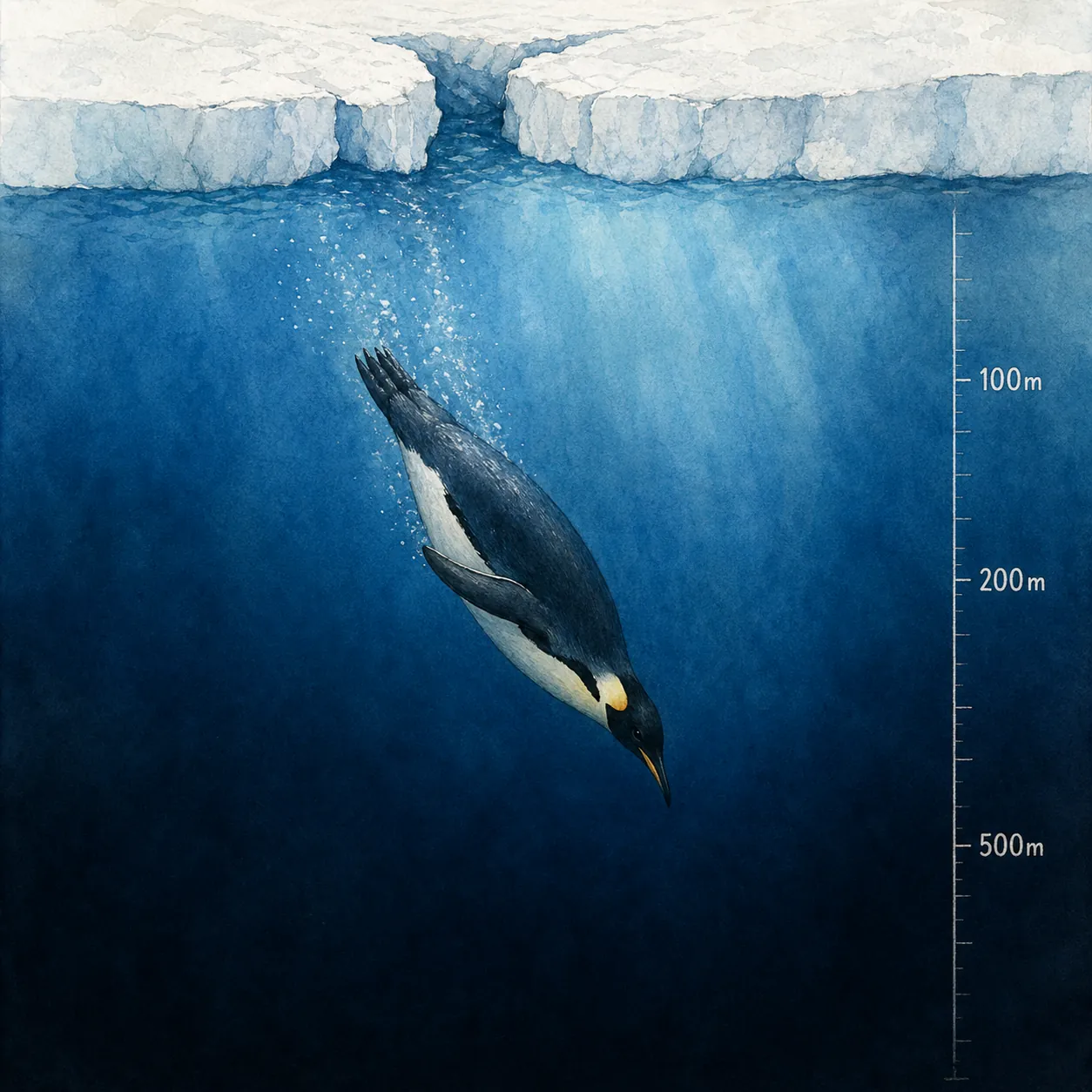
In 2007, a group of emperor penguins, Aptenodytes forsteri, carrying data loggers dived through ice holes in the Ross Sea. When Wienecke and colleagues later read the loggers, the maximum depth was 564 meters.
That number is still the world record for bird diving. Sperm whales can pass 2,000 meters, and Weddell seals can go a little over 600 meters. The emperor penguin sits in between: the feathered animal that has gone deepest.
Underwater for 27.6 minutes
Depth is a static number. What interests researchers even more is how long these penguins stay under.
A 2011 study by Sato and colleagues in J Exp Biol recorded the longest single dive: 27.6 minutes. During that whole period, the penguin could not breathe at all. It relied entirely on the oxygen stored before diving.
Most dives are not that extreme. Emperor penguins usually hunt between 100 and 200 meters, with dives of three to twelve minutes. But even that ordinary schedule is near the edge for a bird.
Their aerobic dive limit, or ADL, is about five to six minutes. After that threshold, the body has to lean on anaerobic metabolism and later needs time to clear lactate. Most dives stay as close as possible within the ADL, shortening recovery time between dives.
The 27.6-minute dive is the record of this system pushed to an extreme. Daily life does not run that way.
A heart rate of 6 beats per minute
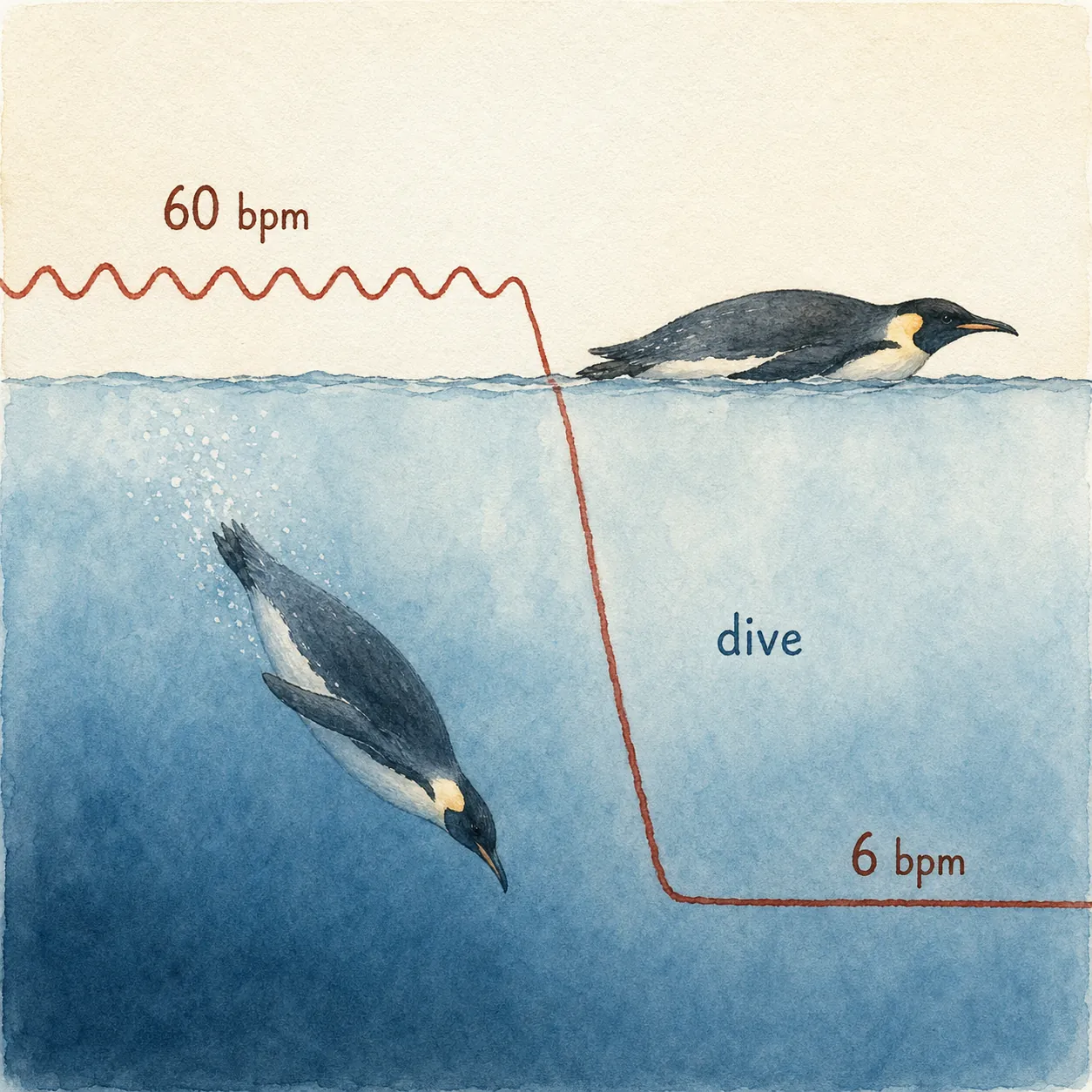
Before entering the water, an emperor penguin’s heart rate is about 60 to 100 beats per minute.
After it dives, that number starts falling.
Meir and colleagues recorded in a 2008 J Exp Biol study that during deep dives, heart rate can drop to 6 beats per minute. This is an actively controlled physiological response called dive bradycardia, triggered by the nervous system after immersion.
When the heartbeat slows, the heart’s oxygen demand drops too. The saved oxygen buys more time.
But the heart is only the entrance to the system. Other things are happening behind it.
Blood flow gets redrawn
Slowing the heart is only the first layer. The more important question is where the blood goes.
At the moment of diving, peripheral blood vessels in the penguin’s body constrict. Blood flow to the flippers, digestive organs, skin, and other “nonessential” areas is reduced first, while supply is concentrated on the heart and brain. The brain still has to judge direction and depth; the heart has to maintain the minimum circulation. Those two cannot be cut off. The rest can wait.
The flippers keep paddling in the water, while the organs inside are entering a kind of partial standby. From the outside, the penguin looks normal. Inside, the blood-supply map has already changed.
At this point the muscles are almost living off their own oxygen store. Blood does not keep delivering fresh oxygen in real time.
This is where myoglobin comes in.
The oxygen bank inside the muscles
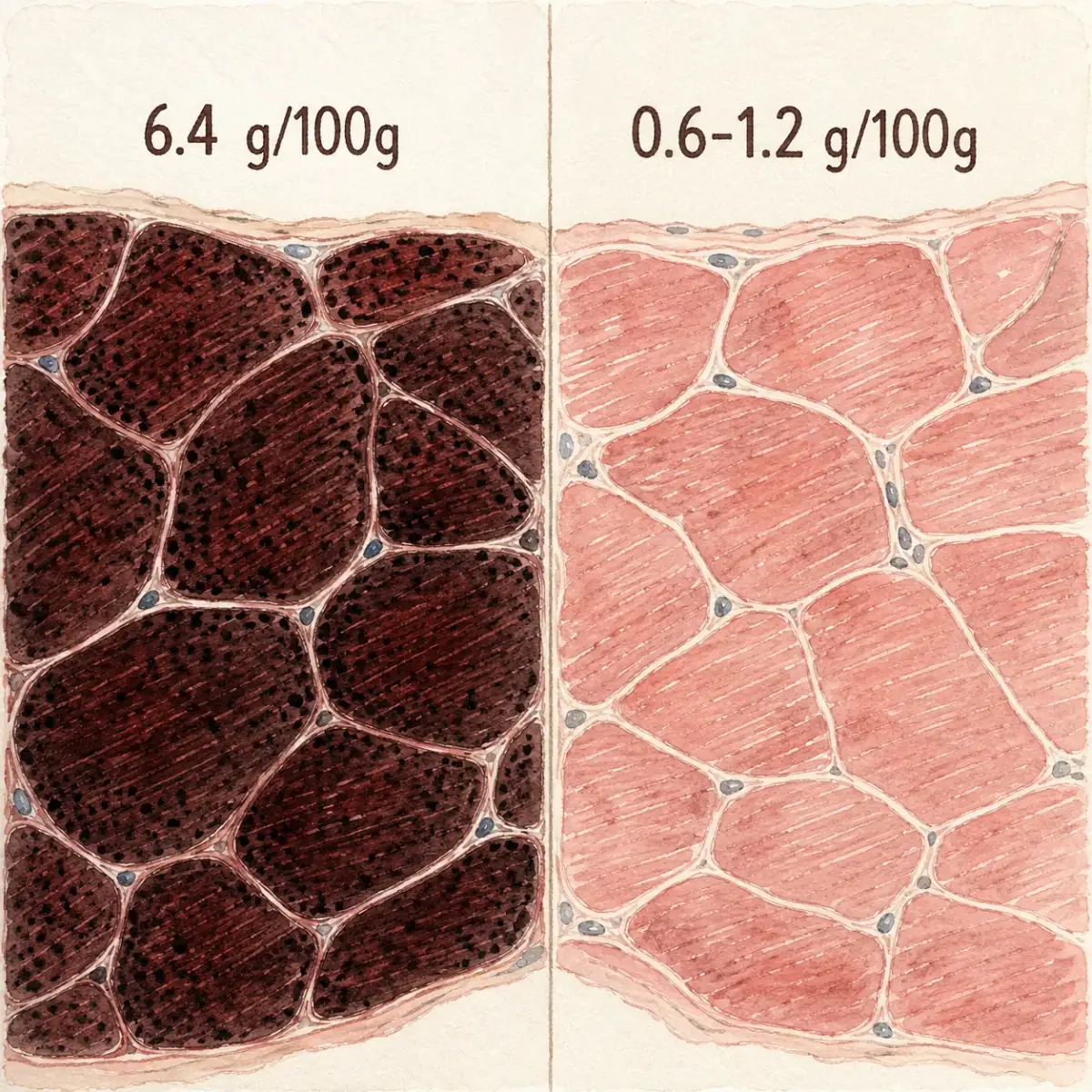
Myoglobin is an oxygen-storing protein found in muscle cells. It is dark red. Muscle with a high concentration can look almost brown-black when cut open.
Emperor penguin myoglobin concentration is about 6.4 grams per 100 grams of muscle, while land birds are usually between 0.6 and 1.2 grams. That is a five- to ten-fold difference.
With such a high concentration, muscles can detach from blood oxygen supply during a dive and keep working independently for longer. Blood flow is reduced, heart rate slows, and the muscles have their own reserve, so they do not run out of oxygen immediately.
But myoglobin has limits too. Once it is used up, it is used up.
Three layers of oxygen allocation
How long that pre-dive breath lasts depends on how the stores are divided beforehand.
Researchers estimate that the emperor penguin’s internal oxygen store is distributed roughly like this: about 70% in muscles, stored by myoglobin; about 28% in blood, carried by hemoglobin, with penguins having higher blood volume and hemoglobin concentration than ordinary birds; and less than 2% in the lungs, the smallest share.
The lungs account for less than 2%, which is the opposite of human intuition. Humans mostly depend on that breath of air when diving. Penguins prepare the oxygen in muscle and blood first, settle the account before entering the water, and only then worry about the little bit of air in the mouth and lungs.
This also explains why penguins can exhale lung air during deep dives, reducing buoyancy and making descent less costly. If the main oxygen supply were in the lungs, doing this would immediately shorten underwater time. They do not have to worry as much.
What we still do not know behind the records
564 meters, 27.6 minutes, and 6 beats per minute each appear in their respective studies. No single paper recorded the same penguin reaching all three extremes at once.
Individual variation is another issue. How deep each penguin can dive, and how low its heart rate falls, varies quite a bit. In Meir and colleagues’ study, heart-rate changes during diving differed by bird, and deep-dive records had small sample sizes, making population-level statistics difficult.
How this physiological system evolved is also not fully resolved. Emperor penguin myoglobin gene regulation, blood properties, and heart-rate control pathways are all being studied separately. Turning them into one integrated model of diving physiology still requires more data.
The line between what researchers are confident about and what remains unanswered is still moving.
I am still reading.
FAQ
How deep can emperor penguins dive?
The recorded maximum is 564 meters, the bird diving record. Daily hunting dives are usually shallower, often around 100 to 200 meters.
Why can a diving penguin heart slow to 6 beats per minute?
Dive bradycardia cuts heart oxygen use and helps reserve oxygen for the brain, heart, and working muscles during a dive.
Do penguins store most dive oxygen in the lungs?
No. In emperor penguins, about 70% is in muscle, about 28% in blood, and less than 2% in the lungs.