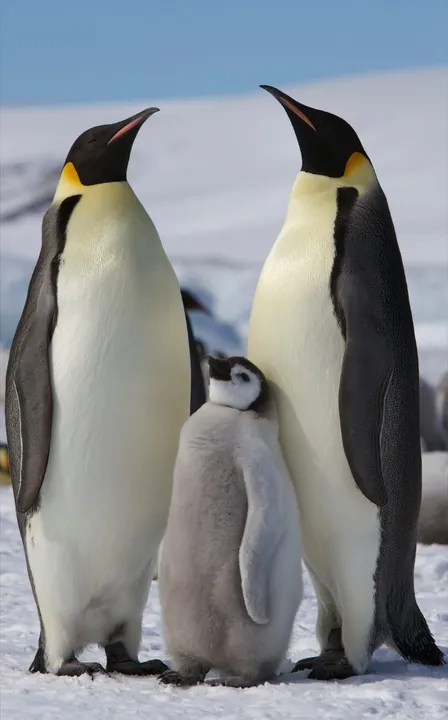
The emperor penguin’s quietest dangerous period is not always the chick scene that cameras love.
It is moult.
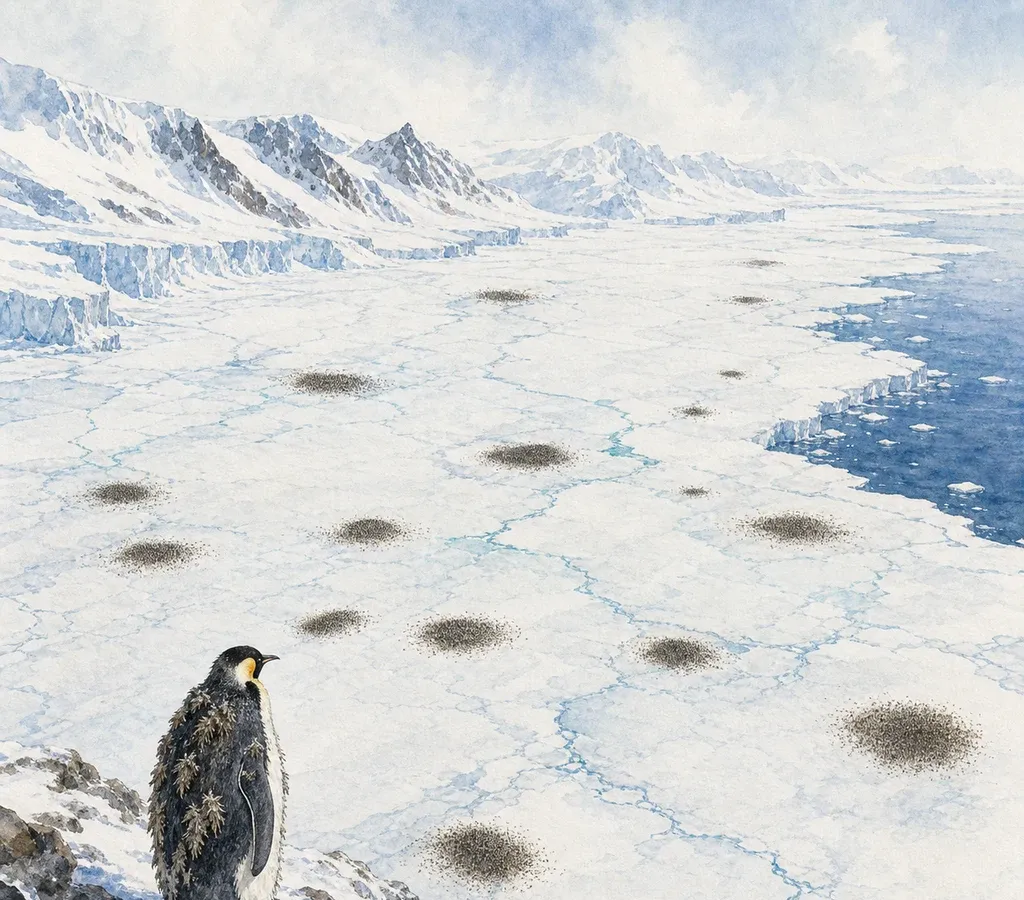
An adult stands on late-summer sea ice, old and new feathers mixed together, the body looking wind-ruffled. It cannot enter the water. The waterproof layer is not ready, and cold water would pull heat away fast. The bird can only live on fat stored before moult and wait for new feathers.
The basic mechanism is covered in the catastrophic moult article. This page adds another layer: the ice under the waiting bird is becoming less predictable.
Satellites first saw dark patches
In 2026, British Antarctic Survey researchers and colleagues published a Communications Earth & Environment study that identified emperor penguin moulting sites from satellite imagery.
The method sounds simple and is not simple at all: look for dark or brown patches on late-summer sea ice around Marie Byrd Land. Those patches can be the penguins themselves, or guano staining the ice. Using Sentinel-2 and WorldView imagery, the team identified large moulting aggregations at a scale that field visits could not easily cover.
The idea connects to penguin guano from space, but the target has shifted from breeding colonies to moult sites.
Moult sites have been hard to study. They are remote, the season is short, sea ice moves and breaks, and ships or aircraft rarely arrive at exactly the right time. Satellite images allow researchers to follow this late-summer window across a wide area.
Moulting adults need stable ice
Emperor penguin moult lasts roughly a month. During that time, the bird cannot feed at sea and should not spend energy moving again and again.
A moulting site needs several things at once: not too far from feeding routes, stable ice, enough standing room, and enough time before break-up.
Fast ice becomes survival equipment here. It is not only for eggs and chicks. It also supports adults that have finished breeding and are preparing to return to the ocean.
The 2026 study suggests that some birds from Ross Sea breeding colonies may travel very long distances to moult, around 1,000 kilometers each way. Moult and breeding do not always happen in the same place. Conservation that only maps breeding sites can miss a major part of the annual cycle.
Less sea ice is not a one-line cause
This is the easiest part to write badly.
Reduced sea ice does not mean every penguin absent from one satellite image died. Birds may have moved, split into smaller groups, or stood in areas not visible on that date.
The study points to a risk pathway.
If fast ice thins, breaks, or disappears before moult finishes, adults may be pushed onto smaller ice, crowd more densely, move closer to open water, or spend more energy relocating. Since they are already fasting, every extra movement burns stored fat.
That is why the news about satellite-discovered moulting sites is worth keeping, but it also needs this evergreen explainer. The news says “we saw them.” This page asks which part of the life cycle must now be recalculated.
Beyond breeding failure, adult survival matters
Sea-ice discussions about emperor penguins often focus on chicks. That makes sense: chicks cannot swim, and early break-up can cause immediate breeding failure.
But a population also depends on adults.
Adults are next year’s breeding capital. A failed moult, high fat loss, or forced route change can affect whether they breed next season, when they breed, and whether they return to the same breeding colony.
Sea-ice risk therefore has at least two layers: chick survival in the current season, and adult physiological cost across the annual cycle.
The emperor penguin story is not only an egg balanced on a father’s feet. It is also a quiet late-summer group of adults standing on ice, feathers not yet ready, while the ice may not wait.
References
- British Antarctic Survey, 2026, satellite discovery of emperor penguin moulting colonies
- Fretwell et al., 2026, Communications Earth & Environment
- Penguin catastrophic moult
- Satellite-discovered emperor penguin moulting sites
FAQ
Why can emperor penguins not swim during moult?
Moult temporarily breaks the waterproof feather layer. Cold water would remove heat quickly, so birds must stand on land or stable ice until the new coat is ready.
What did the 2026 satellite study find?
Researchers used Sentinel-2 and WorldView images to identify large emperor penguin moulting aggregations around Marie Byrd Land from dark patches and guano marks on ice.
Does reduced sea ice mean all missing moulting penguins died?
No. The study points to a higher-risk pathway, but groups may move, split, or use areas not visible in a given image.