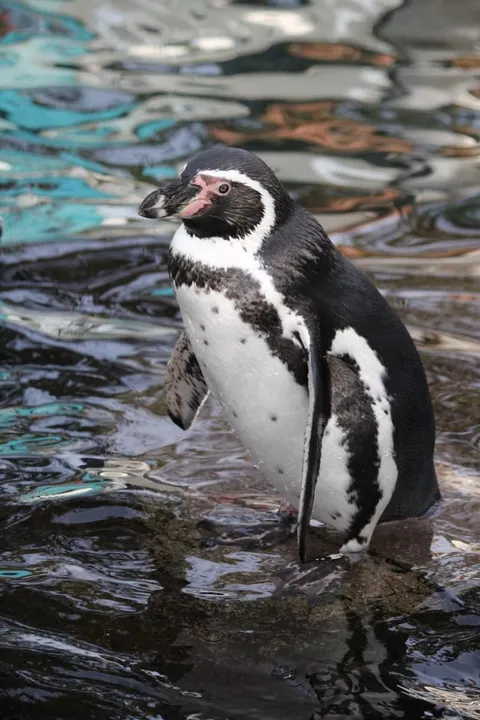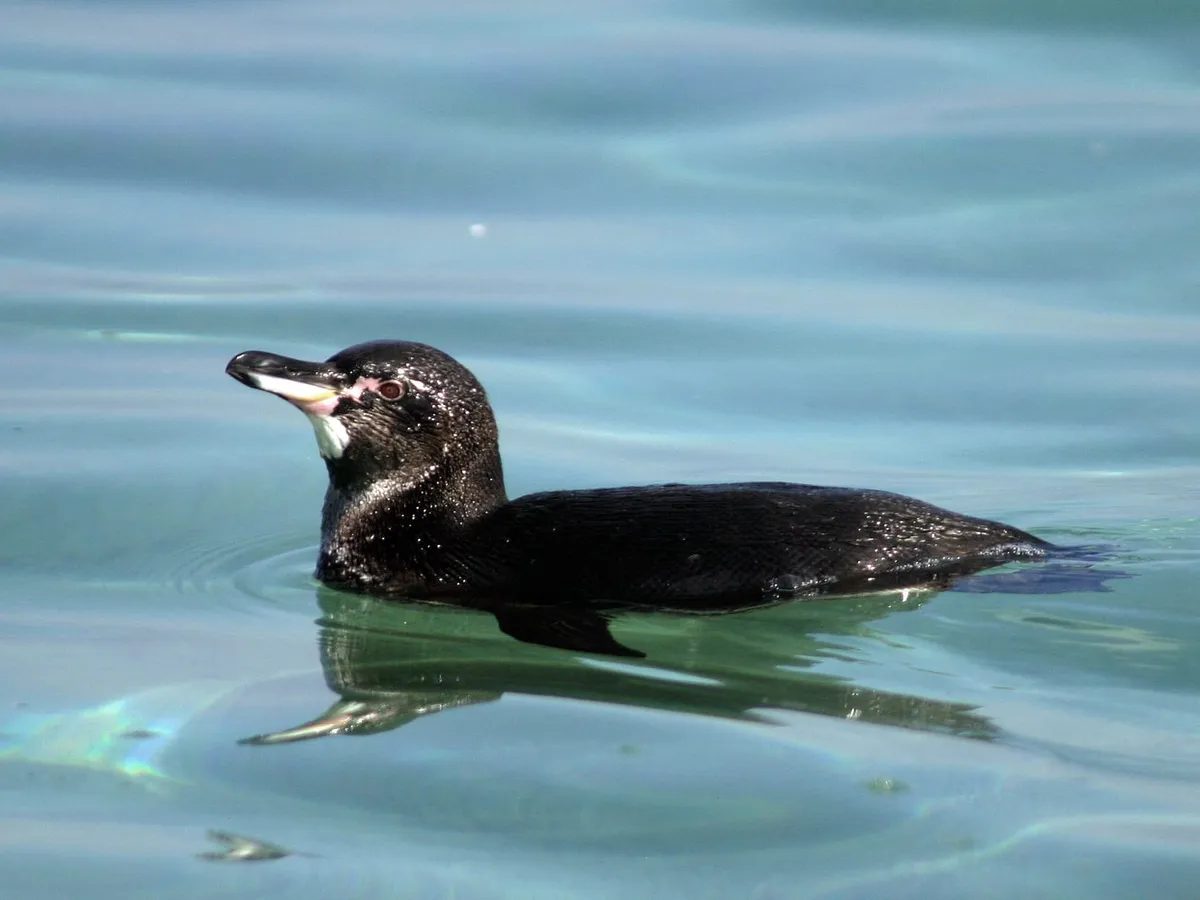
There are penguins near the equator. Every time you hear it, it feels as if the world quietly changed its settings. What is stranger is that Galapagos penguins are not just passing through. They truly make a home there. Lava coast, tropical sun, black rock, and then a penguin tucks itself into shade and waits for cold water to bring fish back.
Galapagos penguins are banded penguins, about 48 to 53 cm tall and 1.7 to 2.6 kg in weight, found mainly around Fernandina Island and the west coast of Isabela Island. They can live at this latitude because the western side of the Galapagos is influenced by cold upwelling, which keeps enough productivity in the sea.
In other words, they can stay because cold current has left them one small place. That small place is precious, and fragile.
Galapagos penguins often nest in rock cracks, lava tubes, or shaded places. Their breeding timing is not rigid; when food is enough, they may breed more than once in a year. Incubation takes about 38 days, and chicks leave the nest after roughly two months. The whole rhythm watches the sea’s face.
If the sea is cold enough and fish are close enough, they can move forward. If the sea warms, especially in a strong El Nino year, prey sinks or declines and breeding success can fall sharply.
A penguin living on shade
Galapagos penguins do not simply tough it out. When they are hot, they spread their flippers, pant, find shade, and slip into lava cracks.
They do not pretend they can conquer heat.
They handle heat honestly. Often mature survival is not about showing strength, but knowing where you cannot take it and leaving an exit early.
They are listed as Endangered, with a common recent estimate of about 1,200 to 1,800 mature individuals and clear year-to-year swings tied to ENSO. That number is small enough that every failed breeding season seems to carry weight. For a species with a tight range and high environmental threshold, losing even a few dozen birds matters.
They cannot hide local failure inside millions of birds. Galapagos penguins do not have that margin.
That is why they feel like a boundary test for the whole penguin world. Any farther north, heat becomes harder; any less cold current, fish become harder to find. Many species live in wide conditions.
They do not. Galapagos penguins tie almost their whole life to one narrow seam of cold water. When it loosens, the body knows first.
How long can an exception last?
They live like a small miracle. The reason is that nature happened to leave a little space there. But a miracle that depends on conditions is never truly easy.
Every day, Galapagos penguins seem to remind us that exceptions exist because the world is still cooperating for the moment.
They are often used as one of the clearest figures in climate stories. The ocean warms, food declines, and a small population is hit.
The logic is clear. What hurts is that they have always lived in a narrow place. They have always been walking a narrow road.
Now the road is narrower.
Galapagos penguins are a beautiful geographic exception.
Exceptions are compelling because they prove the world does not completely follow the textbook. Penguins do not have to live only beside ice; they can also be near the equator.
But exceptions are often exactly what most needs protection, because once the supporting conditions loosen, they have few places to retreat.
Maybe we like exceptions because they make the world feel freer. The hard part is letting exceptions continue to exist.
Galapagos penguins stand on that line, reminding us that freedom is never without conditions; what matters is that those conditions are still here for now.
Their presence near the equator does not mean the equator naturally saved them a seat. It means the cold current was willing to arrive today.