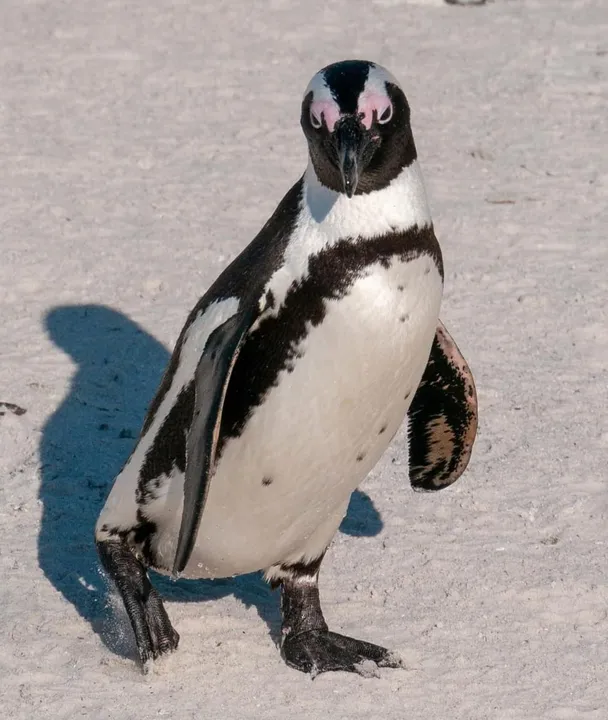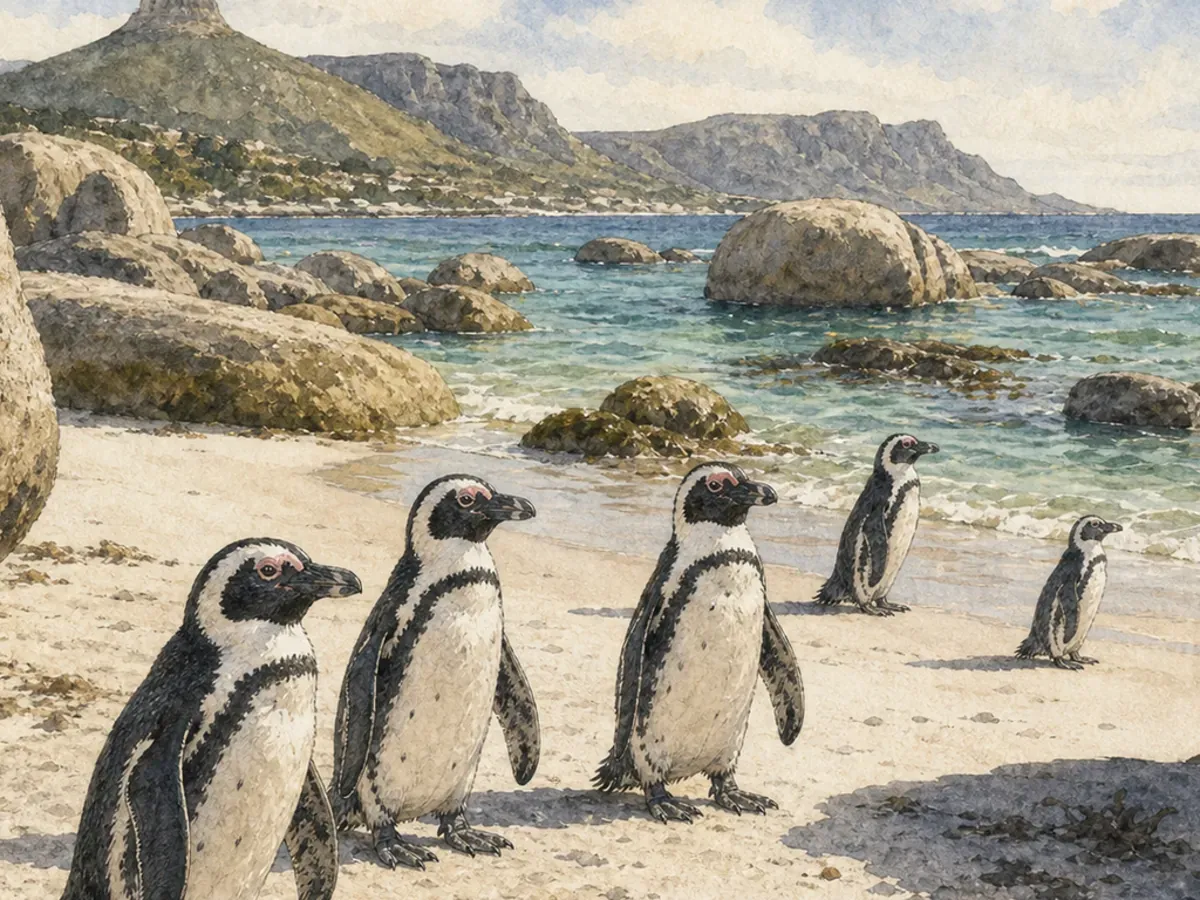
South Africa has wild penguins, and only one species.
That species is the African penguin, scientific name Spheniscus demersus. They are temperate seabirds native to the southern end of Africa.
For the research side of African penguins as individual animals, read penguin personality and individuality. South African field pressure and individual behavior are not completely separate lines.
Where you can see them
The easiest place to arrange is Boulders Beach. It is in Simon’s Town south of Cape Town, belongs to Table Mountain National Park, and is managed by SANParks. Boardwalks let visitors see penguins close up while keeping people on fixed routes.
Another common site is Stony Point / Betty’s Bay. It is farther from Cape Town, usually a little quieter, and also lets visitors see African penguins moving between rocky shore and artificial nest boxes. Robben Island, Bird Island, Dyer Island, and other islands are also tied to African penguin conservation, but they are not all suitable for ordinary travelers to visit independently.
A South African penguin map can be split roughly into two types.
One type is the managed land-based viewing site, such as Boulders and Stony Point, with boardwalks, ticket points, warning signs, and staff. The other is islands and nearshore ecosystems, involving boats, research permits, and fisheries management, where ordinary travelers do not simply step in.
For a first wild penguin visit, Boulders is already enough.
How the conservation line connects
African penguin pressure does not stop at the edge of the beach. They need nearshore fish, and juveniles need safe foraging conditions at sea.
SANCCOB’s role is to bring the results of the sea back onto land. Oiling, malnutrition, dehydration, and chick rescue end up in the work of tubs, towels, feeding tubes, and isolation pools.
That line makes Boulders more than a tourist stop.
If you want a fuller itinerary, separate Boulders and Stony Point into two days. The former is close to Cape Town and works well as a first introduction to African penguins. The latter adds a lower-traffic version, showing the same species under different coastal management conditions.
Neither site is a feeding or interaction tour.
Once that is clear, the travel expectation becomes much healthier.
Before leaving, check ticket prices, tide conditions, and temporary closure notices.
Why African penguins are in such trouble
SANParks’ Boulders material says the first full census in 1956 found about 150,000 pairs of African penguins; by 2009, only about 26,000 pairs remained. The site’s species data currently lists about 19,800 mature individuals, and the IUCN uplisted the species to Critically Endangered (CR) in 2024.
The decline does not have one cause. Shifting sardine and anchovy distributions, oiling, habitat pressure, disease, climate, and fisheries all sit inside it. SANCCOB’s rescue centre receives the results: oiled, dehydrated, injured, and malnourished birds.
What to watch while watching penguins
Do not feed, do not touch, and do not leave the boardwalk. Boulders penguins may look used to people, but they are still wild animals. The official site also warns that their bills are sharp and they will bite if threatened.
Give way while taking photos too. When African penguins move from the sea back to burrows or between shrubs, a person lingering in the wrong place can become a roadblock. Watching from the boardwalk is already close enough.
Best season
African penguins can be seen around Cape Town year-round. For weather and beach travel, Southern Hemisphere spring and summer into early autumn are more comfortable. From a conservation angle, the important thing is to check SANParks hours, prices, and any disease or closure notices before departure.
The contradiction in a South Africa penguin trip is right there: it is one of the easiest wild penguin experiences to arrange, and also a reminder that an easy-to-see species is not necessarily safe.
Every board at Boulders pins that line in place.
FAQ
What wild penguin species lives in South Africa?
South Africa has one wild penguin species: the African penguin, scientific name *Spheniscus demersus*. It is a temperate seabird native to southern Africa.
Where is the easiest place to see penguins in South Africa?
Boulders Beach is the easiest site to arrange, south of Cape Town in Simon's Town and managed by SANParks. Stony Point / Betty's Bay is another common option, farther from Cape Town.
Why are African penguins endangered?
SANParks material says African penguins fell from about 150,000 pairs in 1956 to about 26,000 pairs in 2009. The site's species data lists about 19,800 mature individuals, and the IUCN uplisted the species to Critically Endangered (CR) in 2024.