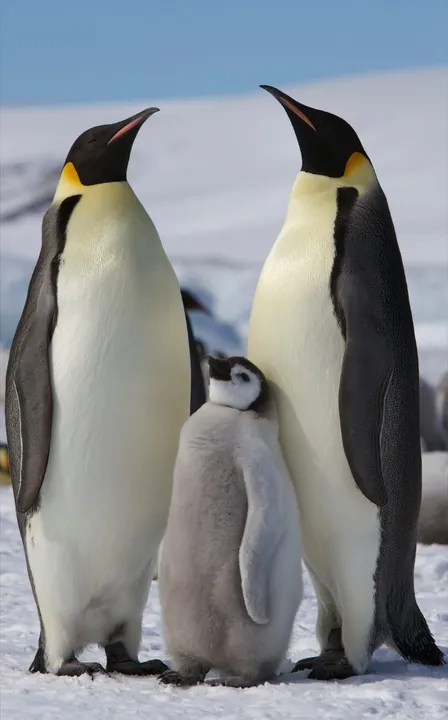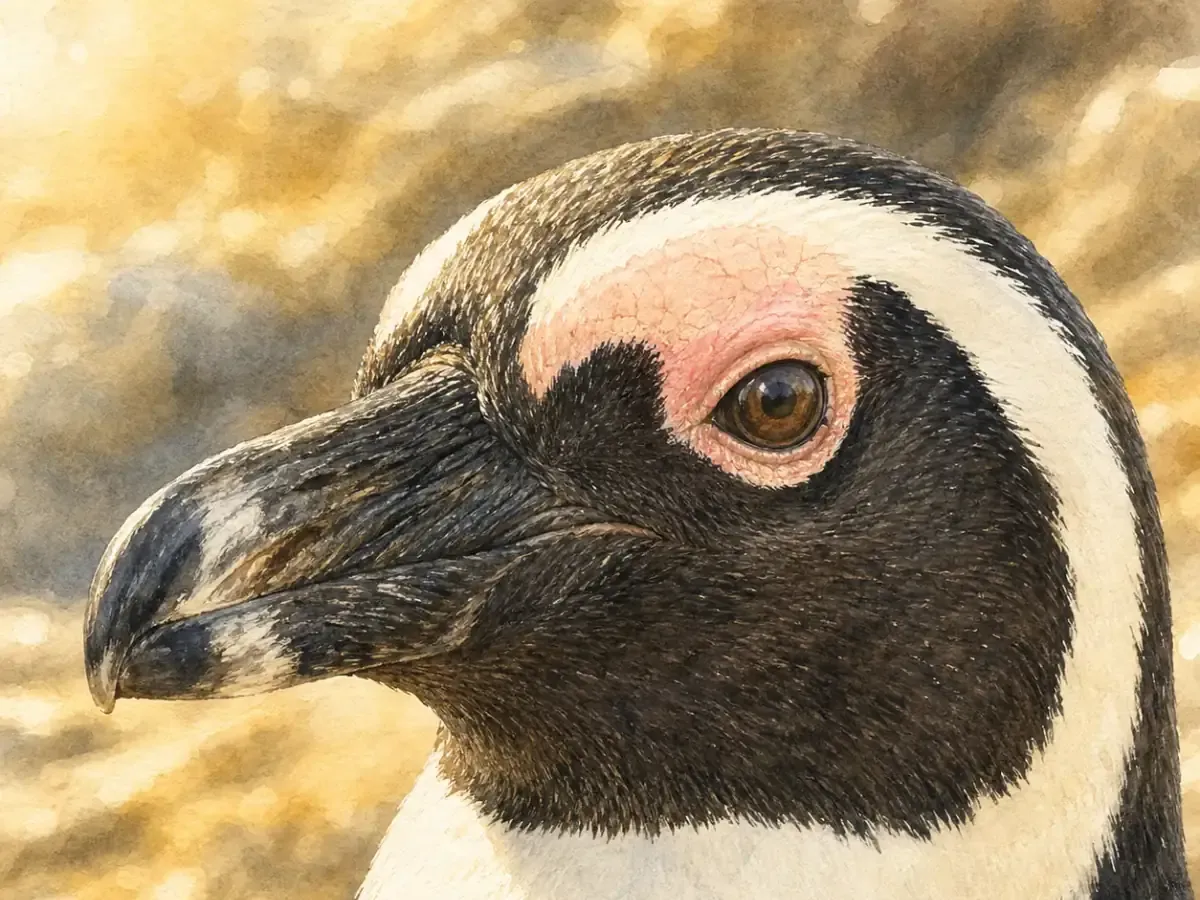
After writing the krill oil article, I paused on another image.
A king penguin colony on South Georgia, from a distance, looks like a black-and-white sea. More than a hundred thousand pairs, pressed together.
Every bird has almost the same feather colors, body shape, and posture. They do not have fixed nests. Eggs and chicks are incubated on the feet, and positions are always shifting.
A parent returns from three weeks at sea, belly full of fish for its chick. As soon as it reaches shore, it has to find that one bird in this sea.

How do they search?
Adelie penguins, Pygoscelis adeliae, and gentoo penguins, Pygoscelis papua, use spatial memory. They have fixed nest sites, stone nests, and when a parent walks into the right area, it uses vision plus short-range calls to confirm. The scene is fixed; the method is to walk back to that point.
King penguins, Aptenodytes patagonicus, and emperor penguins, Aptenodytes forsteri, use a completely different route.
They have no nests. The positions of parents and chicks change every day.
When a hundred thousand similar-looking individuals crowd together, eyes alone cannot find family.
Aubin and Jouventin at the French National Centre for Scientific Research began studying this problem in the 1990s. They set up recording equipment in colonies, recorded calls from different individuals segment by segment, and played them back to see who lifted their head.
In a 2000 Nature paper, they dissected the physical structure of king penguin calls and found a vocal mechanism that is rare among birds.
Two voice channels at once
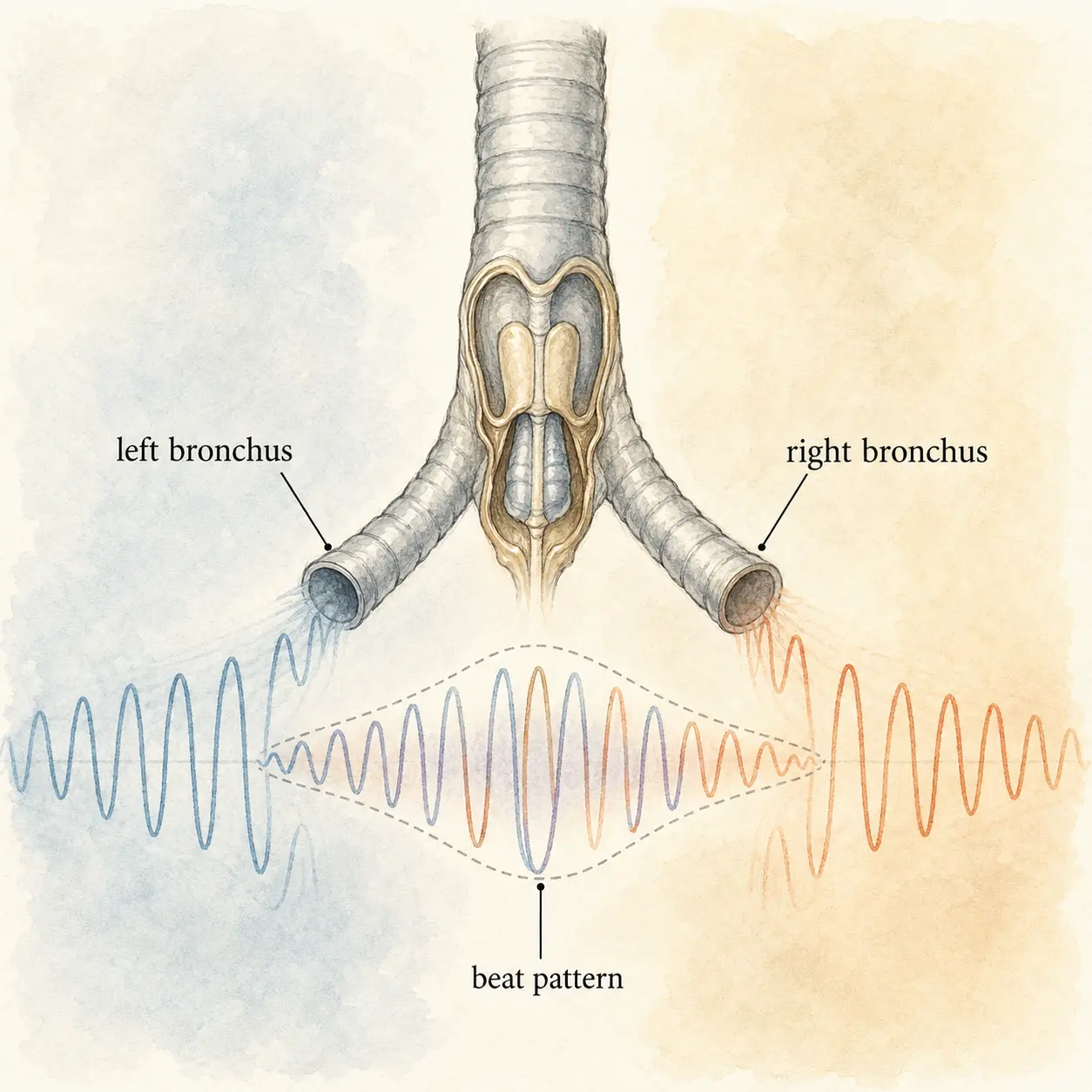
The bird vocal organ is the syrinx, located at the base of the trachea, with one structure on each side. In most birds, the two sides work together and the sound is integrated.
In king penguins, the two sides of the syrinx operate independently and can produce two different frequencies at the same time, separated by about 30 to 50 Hz, creating a distinctive beat pattern.
The combination of those two frequencies is stable and unique for each individual, like a two-channel acoustic fingerprint.
The recognizability of the call depends on the ratio between those two frequencies. Loudness and rhythm are secondary. Even through environmental noise tens of meters away, that frequency pair can still be detected. Background noise in emperor penguin colonies can reach 50 decibels, yet chicks can recognize a parent’s call within a few hundred milliseconds.
How chicks learn
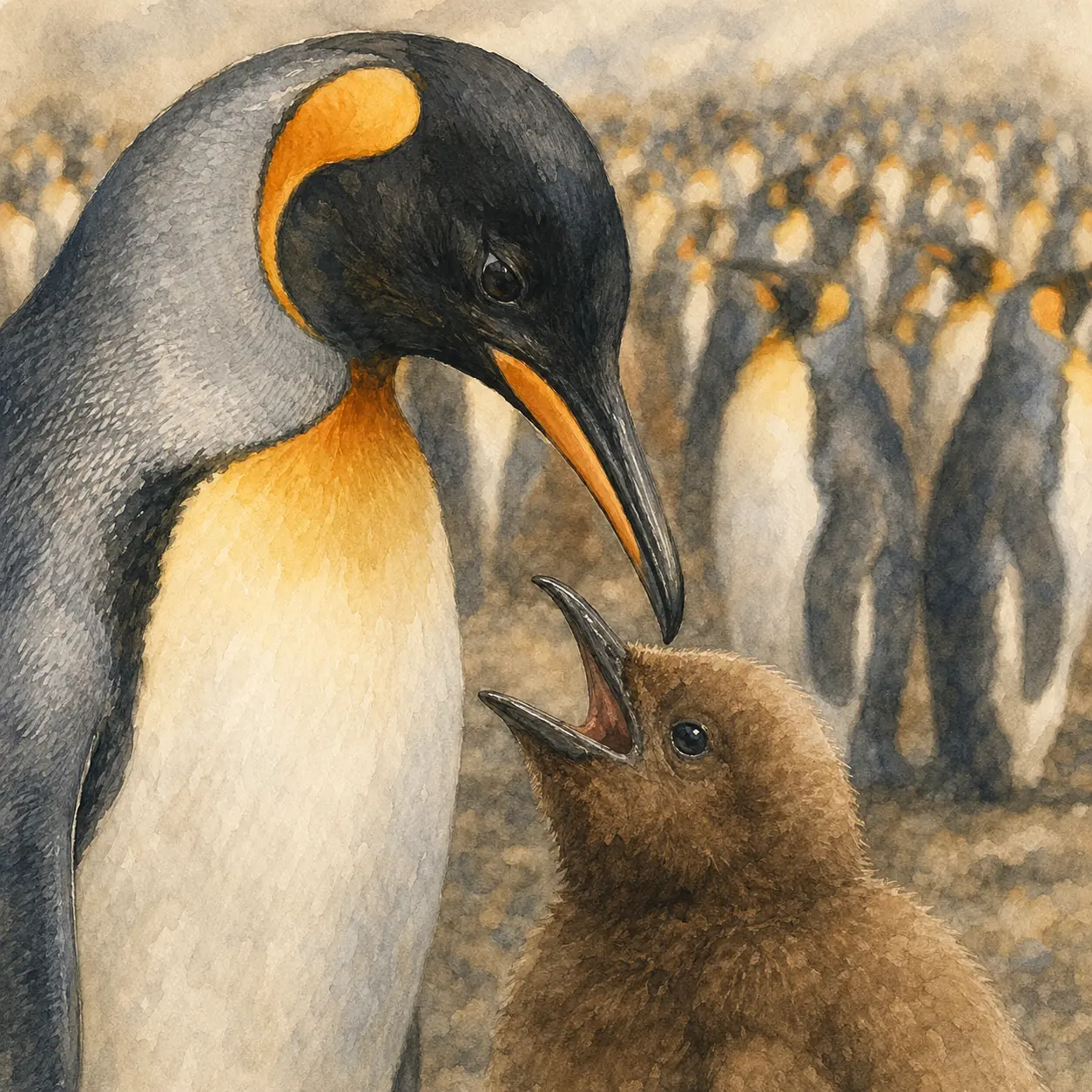
Jouventin and colleagues tracked newly hatched king penguin chicks in a 1999 Behavioural Processes study. Researchers placed recorders beside the parent’s feet, played parental calls to chicks repeatedly, and recorded when the chick lifted its head or turned.
Within a few days after hatching, chicks begin receiving and memorizing parental calls. This imprinting happens in a short time window: the parent calls, the chick stores that frequency set, and the next time it hears it, recognition takes only a few hundred milliseconds. Researchers mixed the parent’s call with calls from other adults and played it again; the chick still lifted its head only for its own parent’s frequency set.
In other words, before chicks have even learned to walk well, they have already built an acoustic ID code. The system works both ways. Parents can also recognize chick calls. Each side’s voiceprint is the only basis for finding the other.
Why make it this complex?
This question is worth pausing on. Evolving a two-channel syrinx has metabolic costs. Maintaining precise acoustic recognition also takes neural processing resources. If vision plus a nest site could solve the problem, there would be no reason to take this path.
The choice made by king and emperor penguins is a compromise forced by extreme environments.
In the Antarctic winter, emperor penguins gather to rear chicks: tens of degrees below zero, no vegetation, no way to build nests, and the group has to pack tightly together to maintain body heat. The egg sits directly between the parent’s feet and brood pouch. The whole nest cannot touch the ground. The concept of a nest simply cannot exist in that environment.
Voiceprint recognition is the only precise way to find someone when there is no fixed position to rely on.
King penguin habitat is somewhat warmer than emperor penguin habitat, but colony size is also enormous. The land competition that fixed nest sites would create pushes them toward the same solution.
How reliable is the system?
Researchers have run interference experiments, playing calls from multiple individuals at the same time and watching which one the target bird chooses. Reaction time and accuracy are both quite stable. One call, a few hundred milliseconds, against a background of a hundred thousand individuals.
Both species in the genus Aptenodytes took this path, which suggests that in this ecological niche, the cost-benefit balance of this solution beats the alternatives.
Adelie and gentoo penguins rely on spatial memory, and that has costs too. Nest sites are affected by Antarctic terrain and sea-ice change. Once habitat is disturbed, the risk of parent-chick separation rises.
Two strategies, each matching its own habitat logic.
Climate change and voice recognition
One direction in Aubin’s later research tracks how recognition rates change as habitat noise increases. Southern Ocean ship noise, ice-shelf cracking, and higher wind speeds partly overlap with penguin call frequencies, and may shrink the effective recognition distance.
Emperor penguin populations are already shrinking rapidly under climate pressure. Changes in ice area affect the size of chick-rearing grounds, and may also squeeze colony density patterns. Whether groups become more dispersed or more concentrated, the noise level that voice recognition must penetrate will change.
The precision of the recognition system itself is clear. But in a rapidly changing environment, where its limits are remains unsettled. Whether a hundred thousand king penguins packed together can keep pulling their own family out of the noise is something I will keep reading about.
FAQ
Why do king penguins need voice recognition?
They have no fixed nest, and parents and chicks move inside huge colonies. Voice is the practical way to find family among similar-looking birds.
What is the beat pattern in penguin calls?
King penguins can use the two sides of the syrinx to produce two frequencies about 30 to 50 Hz apart, creating an individual acoustic fingerprint.
How fast do chicks learn parent calls?
King penguin chicks begin memorizing parent calls within days of hatching and can respond to the right call within a few hundred milliseconds.