While reading, I got stuck on a contradiction.
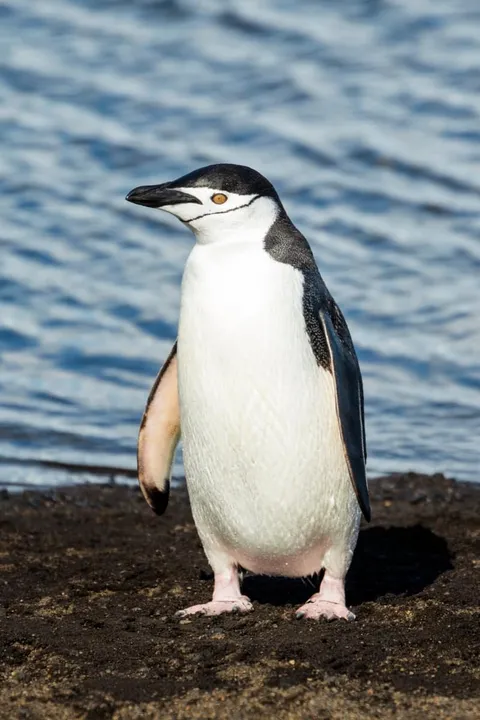
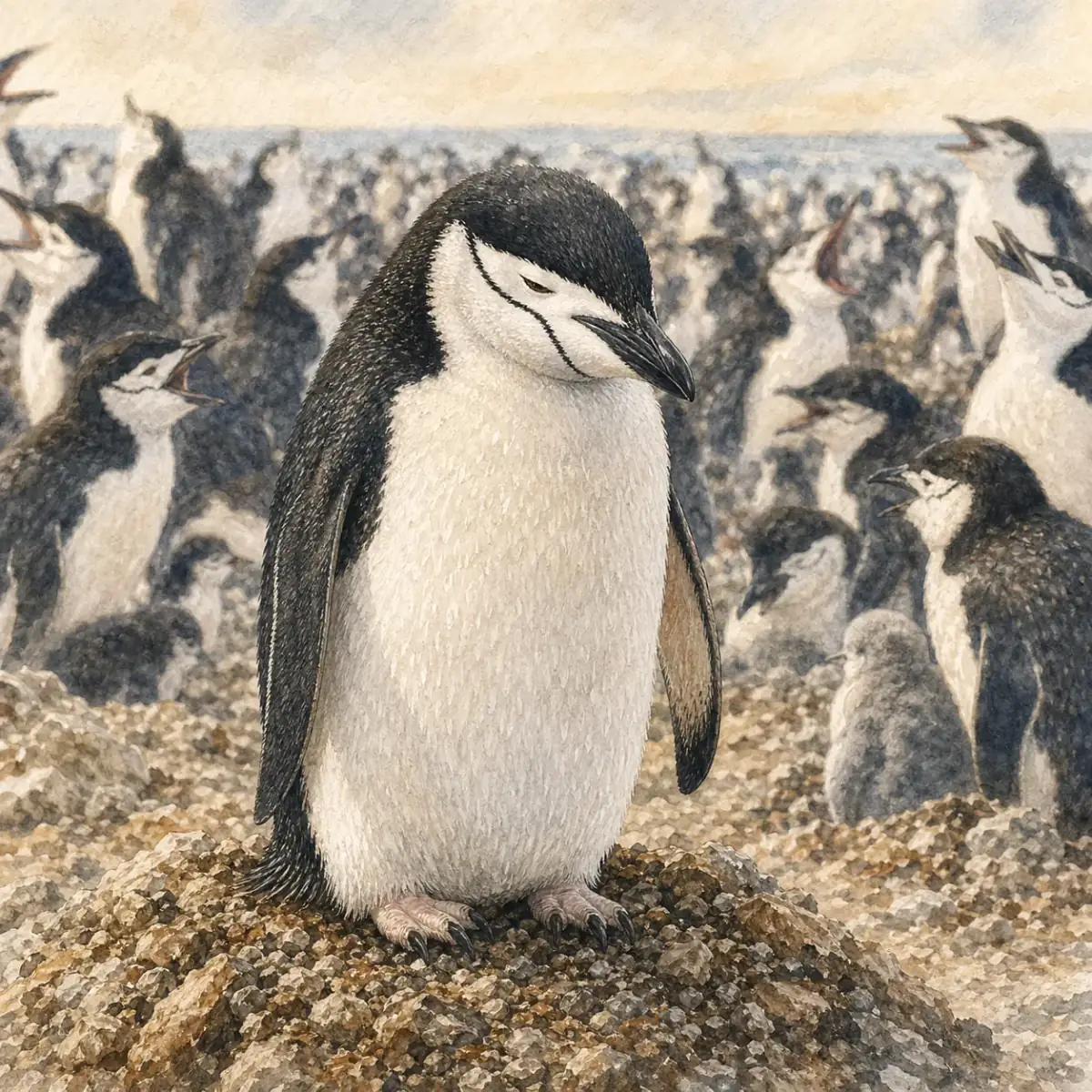
In the chinstrap penguin nesting area on King George Island, the noise never stops. Thousands of penguin pairs crowd together. Neighbors call, wings slap, Antarctic skuas, Stercorarius spp., slice through the air overhead. It all blends into a constant noisy background. During chick-rearing, parents have to guard eggs or chicks all the time. Vigilance cannot stop.
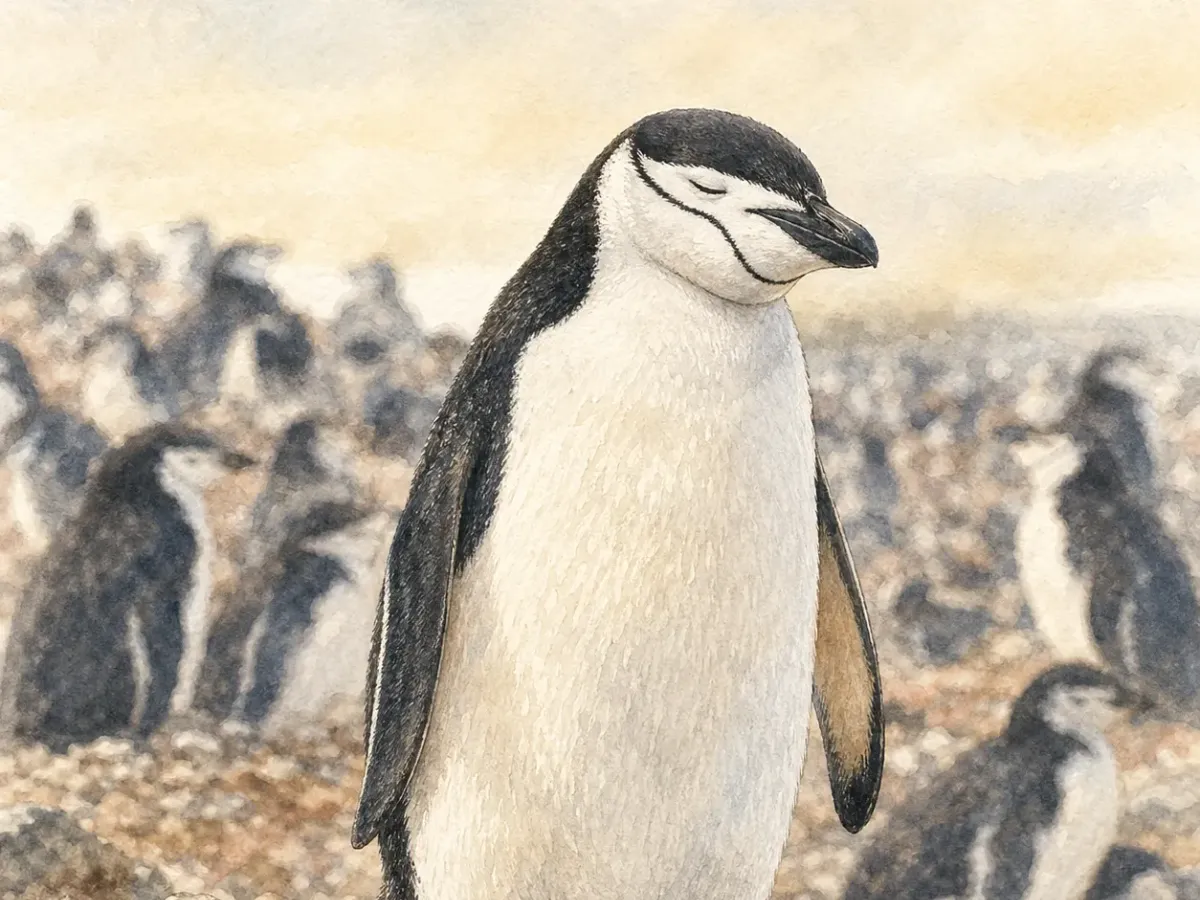
They still fall asleep. Almost 11.4 hours a day. But those 11.4 hours are broken into more than ten thousand brief sleeps, averaging 4 seconds each, scattered across day and night.
The finding comes from Libourel and colleagues’ 2023 study in Science (DOI: 10.1126/science.adh0771). The team tracked 14 brooding chinstrap penguins, Pygoscelis antarcticus, on King George Island and recorded their sleep with EEG. The result is an outlier in sleep science: here, sleep happens every few seconds and ends every few seconds. There are no long blocks, only dense points.
What microsleep means
Microsleep refers to brief fragments in which the brain enters a sleep state, lasting from less than a second to a few seconds.
In humans, microsleep is usually a bad sign. It appears after severe sleep deprivation or driver fatigue. The brain cannot bear the pressure of wakefulness, slips into sleep mode, then switches back, and the person may not notice.
Chinstrap penguin microsleep looks similar, but the mechanism is completely different.
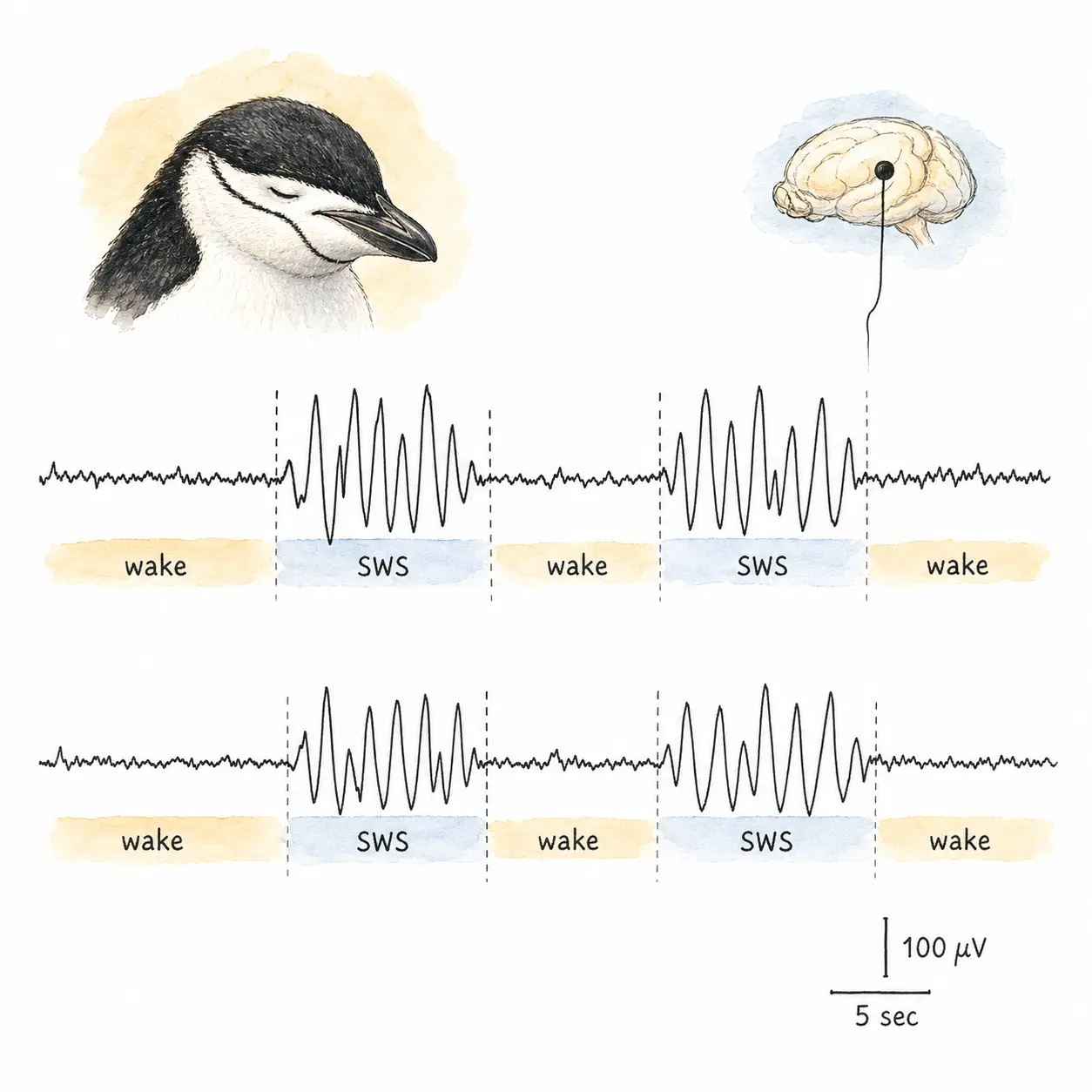
Libourel and colleagues’ EEG records showed that these penguins did not trigger sleep-deprivation markers. They actively distributed sleep into extremely short units, adding them up until they still reached a sufficient total amount of slow-wave sleep, SWS. In each microsleep, the brain fully entered SWS, just for a very short time.
The duration is short. But the SWS work still happens.
The vigilance logic of chick-rearing
Chinstrap penguins breed during the Southern Hemisphere summer, and nesting areas on King George Island often hold thousands of pairs at very high density. That crowding also touches penguin thermoregulation, but the more immediate pressure here is vigilance.
High density brings a problem: Antarctic skuas, Stercorarius spp., treat the whole colony like a buffet. If a parent leaves the nest for more than a few seconds, the egg or young chick may be taken. During pair handoffs, the gap is the most dangerous moment. The noise of colony neighbors also makes quiet difficult.
Libourel and colleagues found that penguins at “edge nests,” closer to the outside of the colony and under higher defensive pressure, had more fragmented microsleep than birds in the core, but their total accumulated sleep time was almost the same.
That result says something important: the body can add sleep back in fragments. The amount can be made up; the cost falls on continuity. Evolution traded away continuous sleep for a version that can be interrupted and resumed at any moment, letting parents recover brain function while still guarding the nest.
Two hemispheres dividing the job
Bird sleep has a known phenomenon: unihemispheric slow-wave sleep, or USWS. Gulls, albatrosses, and other seabirds have records of letting one brain hemisphere sleep while the other stays awake, keeping the corresponding eye open to monitor the environment. Rattenborg’s team found in 2016 that frigatebirds do use USWS during long flights, but much less than they do on the ground, showing that flight still needs a lot of awake brainpower.
Chinstrap penguins are more complicated. Libourel and colleagues found that their slow-wave sleep can be synchronized on both sides, bilateral SWS, or desynchronized, with the two hemispheres operating independently. Which mode appears more often changes with vigilance needs and environmental pressure.
In other words, the penguin brain can be locally controlled and dynamically allocated. The simple frame of “awake or asleep” does not fit here.
Human standards fail here
Sleep medicine defines “healthy sleep” with a familiar set of indicators: 7 to 9 continuous hours at night, complete sleep cycles, light sleep to deep sleep to REM all appearing, and limited awakenings.
Chinstrap penguins break every one of those rules. They fall asleep randomly around the clock, have no concentrated sleep period, and REM sleep records are extremely brief. Some researchers even question whether REM truly completes its function under such fragmented conditions. The restorative function of slow-wave sleep clearly occurs, but the role of REM in this system was not settled in Libourel and colleagues’ paper.
That is also why this study interests sleep scientists so much: SWS can accumulate in fragments this short, but nobody has truly measured whether sleep shattered to this degree carries any cost.
After chick-rearing ends, does penguin sleep change? Does long-term sleep in this style affect cognition? Can cross-species comparisons find other extreme cases? These questions remained open after the 2023 paper.
Why evolution allowed this
Ten thousand microsleeps is an extreme number. Evolution usually does not push a system in such a strange direction unless there is no other option, or unless the cost is acceptable. For chinstrap penguins, the breeding-season pressure is clear: the egg cannot leave the parent’s sight, and the parent cannot skip sleep entirely.
But that answer explains why sleep needs to be scattered. It does not explain why the brain can do it. In humans, sleep pressure is continuous. The longer we stay awake, the more adenosine accumulates, driving sleep. After forced sleep deprivation, the body pays back with rebound slow-wave sleep, but in humans that payback needs continuous sleep.
The chinstrap penguin brain seems to have a different mechanism. It can trigger SWS, complete it, clear it, and wait for the next trigger in 4 seconds. At the molecular level, we do not yet know what that mechanism is.
It may be that bird brains already differ from mammal brains in a way that allows this. It may be that chinstrap penguins evolved a specialized version in this lineage. Or it may be that the same mechanism exists in other penguin species too, and no one has measured it yet.
The part that gives sleep researchers a headache
Most sleep-science models from the past thirty years are built on mammals, especially humans and laboratory rodents. Continuous sleep has been assumed to be necessary, for a simple reason: nobody had observed a system that could function normally under conditions like this. Chinstrap penguins offer a real counterexample.
This counterexample does not mean humans can replace a full night’s sleep with fragmented naps. The neural architecture is too different for direct comparison.
But it does make people reexamine assumptions that had been treated as general principles. What is the smallest effective unit of slow-wave sleep? Is sleep continuity itself the purpose, or just one way to deliver restoration?
Libourel and colleagues noted at the end of their 2023 paper that there is not yet enough cross-species data to answer this question.
Penguins do it ten thousand times a day, four seconds at a time. Whether that has a cost is something I am still following in later papers.
References
Chinstrap penguin microsleep
- Libourel et al., 2023, Science
Comparative bird sleep
- Rattenborg et al., 2016, Nature Communications
- Rattenborg et al., 2009, Neuroscience & Biobehavioral Reviews
FAQ
What did the penguin microsleep study find?
A 2023 Science study tracked 14 brooding chinstrap penguins and found about 11.4 hours of daily sleep split into more than ten thousand bouts averaging 4 seconds.
Why do chinstrap penguins sleep in such short bursts?
During chick rearing they must guard eggs or chicks and watch for skuas. Edge-nest birds had more fragmented microsleeps while keeping similar total sleep.
Does this mean humans can replace sleep with micro-naps?
No. The article treats chinstrap penguins as a specialized bird case, not evidence that humans can replace consolidated sleep.